All published articles of this journal are available on ScienceDirect.

An Augmentation of Abrams’ Law: Correlate Compressive Strength with Water-binder Ratio of Concrete Containing Fly Ash

Abstract
Introduction/Objective
The study presents an augmented form of Abrams’ law that describes the relationship between the strength and water-binder ratio of concrete. This augmentation permits the prediction of the compressive strength of concrete containing fly ash regardless of the mass substitutions of cement by fly ash and the testing age within the ranges of 14-120 days.
Methods
In the modified Abrams’ law, the (apparent) water-binder ratio is replaced by the effective one in which the reactivity of fly ash is considered, and the substitution ratio of fly ash is included. The empirical parameters in the augmented formula have been determined with multi-linear regression analysis based on experimental data.
Results
The goodness of the curve fitting to this renewed strength formula is excellent. The compressive strength predicted from the augmentation coincides with its measured counterpart in the literature.
Discussion
Abrams’ law is augmented by introducing effective water-binder ratio and fly ash replacement rate, and verifies it through regression analysis of experimental and literature data. This topic has practical significance and contributes to the mixture design of sustainable concrete.
Conclusion
The Abrams’ formula is basically simple but has restricted limits of validity. The proposed augmentation improves the accuracy of the strength estimation of sustainable concrete mixtures batched with mineral admixtures such as fly ash.
1. INTRODUCTION
Compressive strength is the most commonly used property for characterizing the performance of concrete materials [1]. It is safe to say that modern concrete technology began with the recognition of the relationship between compressive strength and the water-cement (binder) ratio about one hundred years ago [2, 3]. In general, the compressive strength of a structural concrete is controlled by the strength of its cementing part, i.e., hardened cement paste. The latter is strongly dependent on its porosity. In turn, the (capillary) porosity is a function of the ratio of the quantity of free water involved in the paste portion of the fresh concrete to the quantity of cement in it, i.e., water-cement ratio [2]. In the modern concrete industry, the water-cement ratio is often replaced by the water-binder ratio as supplementary cementitious materials such as fly ash, ground granulated blast furnace slag, and silica fume are widely utilized.
Numerous empirical formulas have been developed to express the relationship between strength and the water-cement ratio, also known as strength formulas. Among them, Abrams’ formula, which was recommended by Duff Abrams in 1918 [4, 5], is a well-known example. Consequently, the relationship between strength and water-cement ratio is usually referred to as Abrams’ law [2, 3]. These formulas estimate concrete strength based solely on the water-cement ratio, and are generally simple and straightforward, but have specific scopes and conditions of application. For example, Iqbal et al. [6] stated that Abrams’ law has limitations when applied to concrete containing admixtures. Hedegaard and Hansen [7] doubted that Abrams’ law is incompatible with concrete mixtures containing fly ash. Bhanja and Sengupta [8] confirmed that Abrams’ law is not directly applicable to silica fume concretes. The original formula should be properly modified and/or augmented.
Fly ash, a byproduct of coal-fired power plants, is well accepted as a pozzolanic material that can be used either as a component of blended Portland cements or as a mineral admixture in concrete. There are beneficial effects on workability and durability with a replacement ratio of cement by fly ash on the order of 25%-30%, while with 50% or more cement replaced by fly ash, it is possible to produce sustainable, high-performance concrete that shows high workability, high long-term strength, and high durability [9, 10]. Higher Volumes (e.g., up to 50%) of Fly Ash (HVFA) have been successfully used for specific structural applications. In some specific cases, structural concrete has been batched with up to 80% fly ash. For flowable fill and low-density applications, concrete mixtures with up to 90% fly ash have been developed. It should be noted that for particularly reactive fly ashes, it is possible to produce acceptable concrete with 100% fly ash. While HVFA has a wide range of benefits, possibly the most attractive property of all is durability. In addition, HVFA is considered an important sustainability measure in the concrete industry.
Despite all the criticisms of Abrams’ law, the water-cement ratio still remains the single most important factor that influences strength development in concrete, where cement is the only cementitious material. According to the current knowledge, the accuracy of applying the water-cement ratio law to concrete with fly ash and silica fume has not been thoroughly verified. Concrete mixes are proportioned so that the desired strengths are obtained at specified ages. To date, the most influential factor on strength development appears to be the water-cementitious material ratio. When the cementitious material is composed of more than cement, the water-cement ratio law may not be an adequate basis for mix proportioning. This study investigates the applicability of the water-cement ratio law to concrete containing fly ash. A substitute water-cementitious material ratio law is proposed to recognize the cementing properties of admixtures such as fly ash. This modified water-cementitious material law is necessary for improved concrete mix design.
In order to accurately predict the compressive strength of concrete containing fly ash with different dosages, this work augments Abrams’ law to extend its applicability. A new compressive strength formula based on the original Abrams’ law is proposed in this paper. The formula has a second independent variable other than the water-binder ratio. Meanwhile, considering the time-dependent reactivity of fly ash, (apparent) water-binder ratios are replaced by effective ones at various ages. The augmented strength formula contains three empirical parameters that are solved with multi-linear regression analysis based on measured strength data. The measured data come from 40 concrete mixtures with various water-binder ratios (ranging from 0.29 to 1.00) and mass substitution ratios (ranging from 0% to 80%) of fly ash. Experimental data in previous literature are utilized to validate the augmented form of Abrams’ law in terms of fly ash concrete.
2. DATA AND METHODS
2.1. Evolution and Augmentation of Abrams’ Law
Duff Abrams initially expressed the relationship between the strength of concrete and its water-cement ratio (0.30 to 1.20) [2-6] defined as Eq. (1):

where, fc is compressive strength (MPa), W/C is water-cement ratio by weight (W and C are weights of water and cement, respectively), and K1, K2 are empirical parameters that are independent of the strength and water-cement ratio of concrete but may be a function of the units, type of cement, aggregate and admixture used, methods of making, curing and testing the specimen, age at testing, and type of strength [3]. It can be transformed into Eq. (2):

Similarly, in Eq. (2), K3 and K4 are also empirical parameters that can be resolved by regression analysis. It is worth noting that Abrams’ law is very similar to Bolomey’s equation [11], which has served as the basis for practical concrete mixture proportioning in many European countries [2] and in China for more than 70 years.
Popovics and Ujhelyi [2] have generalized the basic form Eq. (1): of Abrams’ law to account for the fineness and composition of Portland cement, as well as the testing age. Despite its simplicity, it can reproduce the effects of types and properties of cements on strength development. According to Iqbal et al. [6], the applicability of Abrams’ law is poor for ready-mixed concrete that includes many more variables than trial mixtures. The law has limitations with concrete containing chemical admixtures that modify pore structures (e.g., air-entraining agents). The authors have made modifications to Abrams’ law by replacing w/c with water plus the volume of entrained air. This improves the accuracy of strength prediction to some extent.
Nagaraj and Banu [12] have generalized Abrams’ law in the form of Eqs. (3 and 4), respectively:
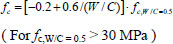
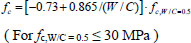
in which, fc,w/c= 0.5 is compressive strength (MPa) when w/c = 0.5. This is equivalent to the reference state to reflect the synergetic effects between constituents of concrete [9, 12]. As stated by Rao [13], Abrams’ law for cement mortars has been formulated with Eqs. (5 and 6):


where α and β are constants in terms of test data. It has been observed that the Abrams’ generalized law is applicable to mortars with W/C greater than 0.40.
Although a great deal of experimental data supports Abrams’ law within practical limits, further analysis indicates that Eqs. (1-6) and other comparable formulas with water-cement ratio as the single independent variable, are correct only as a first approximation [2, 5, 12]. These previous formulas cannot accurately reflect many factors influencing the strength of modern concrete, especially the addition of mineral and chemical admixtures. This has been verified by many experimental evidences [2, 3, 6-8, 14]. Therefore, augmented formulas for strength estimation are needed that include additional variables related to the characteristics of modern concrete composition. As an attempt, the authors introduced the mass substitution ratio of cement by fly ash (FA/B) as a second variable and augmented Eqs. (1 into 7) to correlate the fc of fly ash concrete with its effective water-binder ratio:
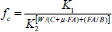
where FA is the quantity of fly ash. B stands for the total weight of binding materials, herein B = C+FA. μ is a factor of pozzolanic reactivity (or cementing efficiency [7, 15]) of fly ash. W/(C+μ·FA) is the effective water-binder ratio, while W/(C+FA) presents the apparent water-binder ratio. This resolves to Eq. (8):

in which, k1, k2 and k3 are empirical parameter. They will be determined with regression analysis in the remainder of this paper.
By multiplying the reactivity factor μ, the weight of fly ash can be transformed into the equivalent weight of cement. According to Mondal and Bhanja [14], the value of μ for any concrete varies from close to zero at very early ages to 0.9 after 3-10 years. After a thorough evaluation, 0.25 and 0.22 were recommended as the average values of μ at the ages of 28 days and 7 days [12, 15]. In this study, 0.15, 0.20, 0.24, and 0.30 are assigned to μ as its values at the ages of 14 days, 28 days, 60 days, and 120 days, respectively.
2.2. Materials
Two types of Portland cement (C-I and C-II) were used. C-I is a sulphate-resistant Portland cement. It is somewhat similar to ASTM type IV cements. C-II is an ordinary Portland cement with higher C3A and C4AF contents. It is similar to ASTM Type I cements. None of the cements used contained fly ash as received from the suppliers. Chemical compositions of the two cements are tabulated in Table 1. Two different fly ashes (FA-I and FA-2) were used. Both are commercially available in China and are from different suppliers. Chemical compositions, specific gravity, and Blaine fineness of the fly ash are also listed in Table 1. Crushed stone with a maximum nominal size of 16 mm and river sand were used as coarse and fine aggregates, respectively. A liquid polycarboxylate-based superplasticizer is also used to regulate the workability of fresh mixtures.
| Items | C-I | C-II | FA-I | FA-II |
|---|---|---|---|---|
| SiO2 (%) | 24.51 | 19.63 | 52.67 | 64.25 |
| Al2O3 (%) | 2.41 | 2.13 | 31.27 | 22.39 |
| Fe2O3 (%) | 2.76 | 2.13 | 5.47 | 6.25 |
| CaO (%) | 66.38 | 63.54 | 3.38 | 2.73 |
| MgO (%) | 0.61 | 3.16 | 1.24 | 1.66 |
| SO3 (%) | 2.26 | 2.73 | 0.25 | 0.53 |
| 1LOI (%) | 0.76 | 2.13 | 2.45 | 2.87 |
| 2Potential typical mineral compounds | ||||
| C2S (%) | 21.95 | 13.83 | --- | --- |
| C3S (%) | 64.05 | 58.17 | --- | --- |
| C3A (%) | 2.06 | 13.58 | --- | --- |
| C4AF (%) | 7.79 | 6.94 | --- | --- |
| Specific gravity | 3.08 | 3.16 | 2.23 | 2.27 |
| 3Blaine fineness (m2/kg) | 376 | 368 | 388 | 349 |
Note: 1LOI stands for loss on ignition; 2Calculated with Bogue’s equation [16], C2S = 2CaO·SiO2, C3S = 3CaO·SiO2, C3A = 3CaO·Al2O3 and C4AF = 4CaO·Al2O3·Fe2O3, 3Test by the Blaine air permeability method.
2.3. Mixture Proportions
Mixture proportions of a total of 40 concretes in the four series of different cement-fly ash combinations (i.e., C-I-FA-I, C-I-FA-II, C-II-FA-I, and C-II-FA-II) are presented in Table 2. The mixtures without the addition of fly ash can be defined as the control mixtures (i.e., Ctrl-C-I and Ctrl-C-II). For some mixtures which were particularly rich in binders, it was necessary to introduce proper dosages of superplasticizer to achieve fresh concrete slump values of 70-100 mm, which is required for all mixtures. However, the main parameters in the investigations, which are water-binder ratios and substitution ratios of fly ash by weight, were carefully maintained on the basis of free water content even when additives were used. The ranges of apparent water-binder ratios and substitution ratios of fly ash are 0.29-1.00 and 0%-80%, respectively.
| Mixture No. | 1W/B | 2FA/B | Unit Contents of Constituent Materials (kg/m3) | Mixture No. | W/B | FA/B | Unit Contents of Constituent Materials (kg/m3) | ||||||||||
|---|---|---|---|---|---|---|---|---|---|---|---|---|---|---|---|---|---|
| 3W | 4C | 5FA | 6S | 7G | 8SP | W | C | FA | S | G | SP | ||||||
| Ctrl-C-I-01 | 1.00 | --- | 200 | 200 | --- | 863 | 1054 | --- | Ctrl-C-II-01 | 1.00 | --- | 200 | 200 | --- | 846 | 1060 | --- |
| Ctrl-C-I-02 | 0.71 | --- | 195 | 273 | --- | 744 | 1156 | --- | Ctrl-C-II-02 | 0.71 | --- | 195 | 273 | --- | 732 | 1116 | --- |
| Ctrl-C-I-03 | 0.56 | --- | 195 | 351 | --- | 677 | 1134 | --- | Ctrl-C-II-03 | 0.56 | --- | 195 | 351 | --- | 670 | 1147 | --- |
| Ctrl-C-I-04 | 0.45 | --- | 195 | 429 | --- | 618 | 1126 | --- | Ctrl-C-II-04 | 0.45 | --- | 193 | 425 | --- | 607 | 1122 | --- |
| Ctrl-C-I-05 | 0.38 | --- | 195 | 507 | --- | 583 | 1077 | 1.17 | Ctrl-C-II-05 | 0.38 | --- | 195 | 507 | --- | 565 | 1096 | --- |
| C-I-FA-I-01 | 0.71 | 0.57 | 175 | 105 | 140 | 711 | 1142 | --- | C-II-FA-I-01 | 0.71 | 0.57 | 176 | 106 | 141 | 696 | 1180 | --- |
| C-I-FA-I-02 | 0.56 | 0.67 | 180 | 108 | 216 | 643 | 1137 | --- | C-II-FA-I-02 | 0.56 | 0.67 | 176 | 106 | 211 | 624 | 1168 | --- |
| C-I-FA-I-03 | 0.45 | 0.73 | 180 | 108 | 288 | 582 | 1083 | 1.54 | C-II-FA-I-03 | 0.45 | 0.73 | 180 | 108 | 288 | 562 | 1126 | 1.27 |
| C-I-FA-I-04 | 0.38 | 0.77 | 180 | 108 | 360 | 543 | 1159 | --- | C-II-FA-I-04 | 0.38 | 0.77 | 176 | 106 | 352 | 524 | 1099 | 3.34 |
| C-I-FA-I-05 | 0.71 | 0.29 | 180 | 180 | 72 | 742 | 1173 | --- | C-II-FA-I-05 | 0.71 | 0.29 | 180 | 180 | 72 | 721 | 1166 | --- |
| C-I-FA-I-06 | 0.56 | 0.44 | 180 | 180 | 144 | 657 | 1137 | --- | C-II-FA-I-06 | 0.56 | 0.44 | 176 | 176 | 141 | 650 | 1191 | --- |
| C-I-FA-I-07 | 0.45 | 0.55 | 180 | 180 | 216 | 578 | 1082 | 1.11 | C-II-FA-I-07 | 0.45 | 0.55 | 180 | 180 | 216 | 577 | 1136 | --- |
| C-I-FA-I-08 | 0.38 | 0.62 | 180 | 180 | 288 | 557 | 1049 | 3.09 | C-II-FA-I-08 | 0.38 | 0.62 | 180 | 180 | 288 | 531 | 1097 | 2.11 |
| C-I-FA-I-09 | 0.33 | 0.67 | 180 | 180 | 360 | 517 | 1167 | --- | C-II-FA-I-09 | 0.33 | 0.67 | 180 | 180 | 360 | 490 | 1052 | 3.83 |
| C-I-FA-I-10 | 0.56 | 0.22 | 180 | 252 | 72 | 685 | 1139 | --- | C-II-FA-I-10 | 0.56 | 0.22 | 176 | 246 | 70 | 660 | 1174 | --- |
| C-I-FA-I-11 | 0.45 | 0.36 | 180 | 252 | 144 | 613 | 1099 | 1.27 | C-II-FA-I-11 | 0.45 | 0.36 | 180 | 252 | 144 | 593 | 1147 | --- |
| C-I-FA-I-12 | 0.38 | 0.46 | 180 | 252 | 216 | 566 | 1066 | 3.28 | C-II-FA-I-12 | 0.38 | 0.46 | 180 | 252 | 216 | 544 | 1110 | 1.68 |
| C-I-FA-I-13 | 0.33 | 0.53 | 180 | 252 | 288 | 525 | 1014 | 6.53 | C-II-FA-I-13 | 0.33 | 0.53 | 176 | 246 | 282 | 509 | 1082 | 4.17 |
| C-I-FA-I-14 | 0.29 | 0.59 | 180 | 252 | 360 | 477 | 1147 | --- | C-II-FA-I-14 | 0.29 | 0.59 | 180 | 252 | 360 | 465 | 1017 | 7.16 |
| C-I-FA-I-15 | 0.45 | 0.18 | 180 | 324 | 72 | 645 | 1116 | 0.79 | C-II-FA-I-15 | 0.45 | 0.18 | 180 | 324 | 72 | 611 | 1155 | 0.99 |
| C-I-FA-I-16 | 0.38 | 0.31 | 180 | 324 | 144 | 575 | 1084 | 3.46 | C-II-FA-I-16 | 0.38 | 0.31 | 180 | 324 | 144 | 558 | 1122 | 2.06 |
| C-I-FA-I-17 | 0.33 | 0.40 | 180 | 324 | 216 | 534 | 1035 | 6.21 | C-II-FA-I-17 | 0.33 | 0.40 | 176 | 317 | 211 | 520 | 1096 | 3.64 |
| C-I-FA-I-18 | 0.29 | 0.47 | 180 | 324 | 288 | 476 | 1117 | 1.84 | C-II-FA-I-18 | 0.29 | 0.47 | 176 | 317 | 282 | 484 | 1048 | 7.97 |
| C-I-FA-I-19 | 0.38 | 0.15 | 180 | 396 | 72 | 601 | 1985 | 2.53 | C-II-FA-I-19 | 0.38 | 0.15 | 180 | 396 | 72 | 572 | 1135 | 2.62 |
| C-I-FA-I-20 | 0.33 | 0.27 | 180 | 396 | 144 | 559 | 1170 | --- | C-II-FA-I-20 | 0.33 | 0.27 | 176 | 387 | 141 | 534 | 1108 | 3.85 |
| C-I-FA-II-01 | 0.71 | 0.57 | 180 | 108 | 144 | 694 | 1176 | --- | C-II-FA-II-01 | 0.71 | 0.57 | 180 | 108 | 144 | 696 | 1169 | --- |
| C-I-FA-II-02 | 0.56 | 0.67 | 175 | 105 | 210 | 628 | 1132 | --- | C-II-FA-II-02 | 0.56 | 0.67 | 176 | 106 | 211 | 628 | 1171 | --- |
| C-I-FA-II-03 | 0.45 | 0.73 | 180 | 108 | 288 | 565 | 1091 | 1.31 | C-II-FA-II-03 | 0.45 | 0.73 | 176 | 106 | 282 | 573 | 1143 | 0.50 |
| C-I-FA-II-04 | 0.38 | 0.77 | 180 | 108 | 360 | 523 | 1167 | --- | C-II-FA-II-04 | 0.38 | 0.77 | 176 | 106 | 352 | 679 | 1116 | 2.89 |
| C-I-FA-II-05 | 0.71 | 0.29 | 180 | 180 | 72 | 724 | 1167 | --- | C-II-FA-II-05 | 0.72 | 0.28 | 176 | 176 | 70 | 725 | 1169 | --- |
| C-I-FA-II-06 | 0.56 | 0.44 | 180 | 180 | 144 | 639 | 1146 | --- | C-II-FA-II-06 | 0.56 | 0.44 | 176 | 176 | 141 | 645 | 1177 | --- |
| C-I-FA-II-07 | 0.45 | 0.55 | 180 | 180 | 216 | 580 | 1104 | 0.79 | C-II-FA-II-07 | 0.44 | 0.55 | 176 | 180 | 216 | 582 | 1139 | --- |
| C-I-FA-II-08 | 0.38 | 0.62 | 180 | 180 | 288 | 534 | 1059 | 2.34 | C-II-FA-II-08 | 0.38 | 0.62 | 176 | 176 | 282 | 542 | 1116 | 0.92 |
| C-I-FA-II-09 | 0.33 | 0.67 | 180 | 180 | 360 | 496 | 1172 | --- | C-II-FA-II-09 | 0.33 | 0.67 | 176 | 176 | 352 | 503 | 1073 | 2.32 |
| C-I-FA-II-10 | 0.56 | 0.22 | 180 | 252 | 72 | 659 | 1167 | --- | C-II-FA-II-10 | 0.56 | 0.22 | 180 | 252 | 72 | 658 | 1170 | --- |
| C-I-FA-II-11 | 0.47 | 0.36 | 180 | 245 | 140 | 604 | 1133 | 1.16 | C-II-FA-II-11 | 0.45 | 0.36 | 176 | 246 | 141 | 603 | 1160 | --- |
| C-I-FA-II-12 | 0.40 | 0.46 | 180 | 245 | 210 | 556 | 1074 | 2.28 | C-II-FA-II-12 | 0.39 | 0.46 | 176 | 246 | 211 | 553 | 1128 | 1.28 |
| C-I-FA-II-13 | 0.33 | 0.53 | 180 | 252 | 288 | 505 | 1026 | 4.27 | C-II-FA-II-13 | 0.33 | 0.53 | 176 | 246 | 282 | 513 | 1086 | 2.69 |
| C-I-FA-II-14 | 0.29 | 0.59 | 180 | 252 | 360 | 470 | 1159 | --- | C-II-FA-II-14 | 0.29 | 0.59 | 176 | 246 | 352 | 478 | 1040 | 4.43 |
| C-I-FA-II-15 | 0.45 | 0.18 | 180 | 324 | 72 | 613 | 1127 | 0.59 | C-II-FA-II-15 | 0.45 | 0.18 | 176 | 317 | 70 | 618 | 1168 | 0.54 |
| C-I-FA-II-16 | 0.38 | 0.31 | 180 | 324 | 144 | 560 | 1086 | 2.06 | C-II-FA-II-16 | 0.38 | 0.31 | 176 | 317 | 141 | 563 | 1133 | 2.02 |
| C-I-FA-II-17 | 0.33 | 0.40 | 180 | 324 | 216 | 518 | 1035 | 6.48 | C-II-FA-II-17 | 0.33 | 0.40 | 176 | 317 | 211 | 524 | 1099 | 3.22 |
| C-I-FA-II-18 | 0.29 | 0.47 | 180 | 324 | 288 | 478 | 1137 | 1.84 | C-II-FA-II-18 | 0.29 | 0.47 | 176 | 317 | 282 | 487 | 1054 | 6.65 |
| C-I-FA-II-19 | 0.38 | 0.15 | 180 | 396 | 72 | 575 | 1099 | 1.87 | C-II-FA-II-19 | 0.39 | 0.15 | 176 | 387 | 70 | 581 | 1147 | 2.15 |
| C-I-FA-II-20 | 0.33 | 0.27 | 180 | 396 | 144 | 529 | 1106 | --- | C-II-FA-II-20 | 0.33 | 0.27 | 176 | 387 | 141 | 535 | 1111 | 2.32 |
Note: 1W/B = water-binder ratio; 2FA/B = fly ash to total binders (including cement and fly ash) ratios; 3W = water; 4C = cement; 5FA = fly ash; 6S = quartz sand; 7G = crushed granite; 8SP = super-plasticizer.
To improve the representation of the mix design of concrete, specific water/binder and fly ash/binder ratio ranges were chosen based on several typical databases of mixture proportions for ready-mixed concrete used in commercial reinforced concrete buildings. Considering the scope of application of the extension of Abrams’ law, the mixtures with a water/binder ratio higher than 0.45 were also included. The range of fly ash/binder ratio were prescribed to cover the overwhelming majority of engineering applications in China.
2.4. Testing Procedures
Twelve 100 mm cubic specimens for compressive strength tests were fabricated from each mixture listed in Table 2. Three specimens were tested for strength in accordance with the Chinese national standard (GB 50081-2019) [17] after 14, 28, 60, and 120 days of continuous water curing at 20 oC. Immediately after casting, the cubic specimens with steel moulds were first stored in isothermal curing chambers (20 °C) for 24 hours, then stripped and placed in saturated lime water until the specific age of testing.
3. RESULTS AND DISCUSSION
Experimental data are presented that suggest that the development of strength in fly ash concretes may be due to two mechanically independent pore-filling mechanisms. One mechanism is hydration of Portland cement, and the other mechanism is due to the reaction of fly ash. Moreover, it is postulated that the traditional water/cement ratio for normal Portland cement concrete, produced without fly ash, can be modified to accommodate concrete containing FA.
For given materials, age, and curing conditions, the strength of hardened concrete is determined exclusively by the ratio of free water to Portland cement, together with the ratio of free water to fly ash. Thus, the strength of fly ash concrete is independent of the absolute content of free water, Portland cement, and fly ash in the concrete.
When dealing with concrete, which is inherently highly variable, a coefficient of determination R2) above 0.95 in a regression analysis usually indicates a strong relationship between a hypothetical model of concrete and corresponding experimental data. The maximum theoretically possible R2 value of 1.00 would indicate perfect correlation between theory and experiments. Because of unavoidable experimental scatter, R2 values above 0.95 are rarely obtained in concrete testing. The relatively high R2 value observed in this study may not necessarily indicate overfitting. R2 is a measure of model fit, and the values close to 1 often indicate good performance. However, to assess overfitting, other factors to consider include model complexity, data representativeness, and validation metrics. Overfitting can occur when the model captures noise or irrelevant patterns in the training set rather than generalizable relationships. To mitigate this, techniques like cross-validation, regularization, or simplifying the model architecture can be employed.
For all four series of experimentally investigated concrete mixtures, a statistical analysis was conducted to evaluate how accurate the measured test results conform to predictions by the augmented formula of strength (i.e., Eq. 8)). A multilinear regression analysis, based on the least-squares method, has been used to calculate the best-fitting line and the best estimates of the empirical parameters (or constants) in each case. The analysis was performed using the MATLAB R2011b software package. All the results of regression analysis, including the values of k1, k2, and k3 and R2 (i.e., coefficient of correlation), were listed in Table 3. For example, several 3D plots of data fitting are shown in Fig. (1a-d).
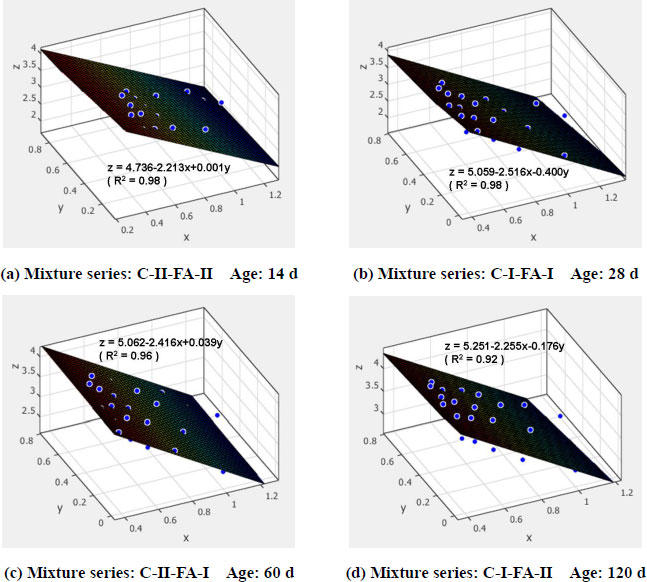
Partial multi-linear regression analysis results of the augmented Abrams’ formula. (In these 3D plots, x, y, and z-axis represent effective water-binder ratio, substitution ratio of fly ash, and natural logarithm of compressive strength, respectively. Blue points are the measured data. The planes are the best results of regression analysis.)
| Parameters | k1 | k2 | k3 | Coefficients of Correlation (R2) |
|---|---|---|---|---|
| Mixture series: C-I-FA-I | ||||
| 14 d | 4.801 | 2.513 | 0.032 | 0.94 |
| 28 d | 5.059 | 2.516 | 0.400 | 0.98 |
| 60 d | 5.236 | 2.524 | 0.299 | 0.94 |
| 120 d | 5.378 | 2.472 | 0.391 | 0.92 |
| Mixture series: C-I-FA-II | ||||
| 14 d | 4.873 | 2.528 | 0.246 | 0.97 |
| 28 d | 5.100 | 2.587 | 0.237 | 0.98 |
| 60 d | 5.196 | 2.420 | 0.197 | 0.94 |
| 120 d | 5.251 | 2.255 | 0.176 | 0.92 |
| Mixture series: C-II-FA-I | ||||
| 14 d | 4.748 | 2.236 | -0.033 | 0.96 |
| 28 d | 4.922 | 2.321 | -0.037 | 0.96 |
| 60 d | 5.062 | 2.416 | -0.039 | 0.96 |
| 120 d | 5.157 | 2.427 | -0.110 | 0.94 |
| Mixture series: C-II-FA-II | ||||
| 14 d | 4.736 | 2.213 | -0.001 | 0.98 |
| 28 d | 4.860 | 2.240 | -0.029 | 0.98 |
| 60 d | 4.981 | 2.271 | -0.118 | 0.97 |
| 120 d | 5.013 | 2.230 | -0.276 | 0.95 |
When dealing with concrete, which is inherently an extremely variable material, a coefficient of determination (R2) above 0.95 in a regression analysis usually indicates a strong fit between a mathematical model and the corresponding measured data. Due to unavoidable experimental scatter, R2 values above 0.95 are not readily obtained for concrete data [6, 9, 14]. Considering that most of R2 values are at 0.95 or above (Table 3), it may be concluded that the augmented formula Eq. (8) is highly compatible with concrete mixtures containing fly ash with a wide range of dosages.
As presented in Table 3, it seems that the values of k1 are systematically increased with the ages of strength evaluation for each series of fly ash mixtures, while the values of k2 and k3 change irregularly. Compared with the values of k3, those of k1 and k2 change within relatively narrow ranges. This implies that the ultimate strength and the influence of the water-binder ratio on compressive strength are unchanged across specific ages, mixture proportions, and fly ash replacement ratios. The negative values of k3 for the mixture series of C-II-FA-I and C-II-FA-II indicate that the positive effects on the strength development with different degrees are produced by the inclusion of fly ash.
As fly ash contributes to the strength increase with age, the value of k3 decreases with age. Despite these results obtained from different combinations of cements and fly ashes (Table 1), the values of the three empirical parameters are slightly changed. To be honest, as an extension of Abrams’ law, Eq. (8) was not rigorously mechanistically developed. Therefore, the implications of the beneficial effect of fly ash on the negative value of k3 are not easy to interpret at this point [19].
In Fig. (1), the relationships among compressive strength, water-binder ratio, and replacement ratio of fly ash are plotted in log-linear 3D coordinate systems. The blue points represent measured compressive strength values. The planes are the best results of regression analysis. It is evident that the fitting surfaces match well with the tested data of compressive strength. Although four plots are presented here, all results of the 3D linear regression analysis of various mixture series at different ages closely match the corresponding experimental data.
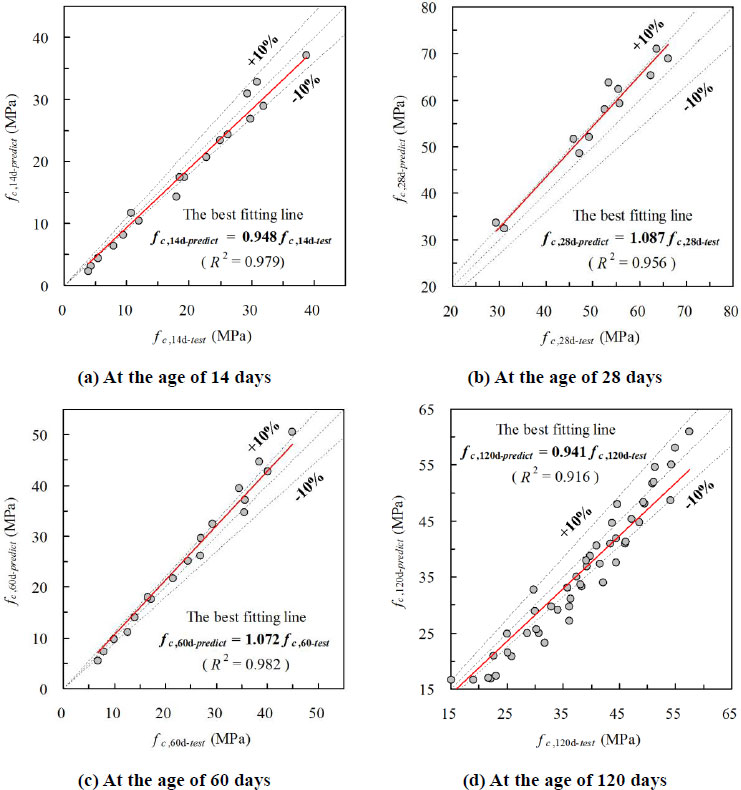
To validate the applicability of the proposed augmented form of Abrams’ law, the experimental compressive-strength data from the literature are compared with the predicted values. The measured data are cited from three sources on fly ash concrete [10, 13, 14]. The values of the three parameters are based on average values in Table 3. The comparisons of the predicted values and the measured data at different ages are plotted in Fig. (2a-d), respectively [10, 14, 18]. In general, the predicted compressive strength is very close to the measured results. The augmented formula based on Abrams’ law permits the prediction of compressive strength of concrete containing fly ash [19]. For the ages of 14 days and 120 days, the predicted values of compressive strength are slightly lower than their measured values. However, the opposite is true for the ages of 28 days and 60 days. Taking many differences of constituent materials and mixture proportions into account, the minor deviations between the predicted and measured values are reasonable and tolerable.
Despite Abrams’ law, which is considered a fundamental principle of concrete mixture proportioning is an empirical approximation other than a physical law in nature; it remains valid and useful within a relatively wide range of concrete mixture proportions. However, when fly ash from coal-fired power plants is commonly used as a mineral admixture in normal Portland cement concrete, the mixture design becomes more complex than for pure Portland cement concrete mixtures, and the original edition of Abrams’ law is ineffective. In this study, an extension of Abrams’ law that applies to concrete mixtures containing fly ash is formulated and demonstrated based on a series of self-designed experimental data. Notably, the relationship between mechanical strength and water-cement/binder ratio of concrete is strongly dependent on constituent materials, mixture proportions, and specific testing conditions. The parameters in the formula of the extended Abrams’ law certainly vary from one testing system to another. Therefore, in order to accurately estimate compressive strength based on water-cement/binder ratio and vice versa, a sufficient quantity of experimental data that presents various conditions and their combinations must be collected and analyzed. In the current situation, maybe the AI tools can be employed to achieve the objective conveniently. The process of further developing the augmentation of Abrams’ law with the aid of artificial intelligence is in progress. On the other hand, the physical mechanisms of Abrams’ law and its extensions are urgently needed to be explored and interpreted. The implication of the macroscopic-scale strength-W/B relationship and the hydration kinetics/micro-structural evolution of concrete materials is a promising topic worthy of exploration. In addition, the mixture proportioning method based on Abrams’ law must be updated and expanded to account for modern concrete, which contains many more components.
CONCLUSIONS
This study presents an augmentation of the famous Abrams’ law correlating the strength of concrete with its water-cement ratio. The augmented strength formula can accurately predict the compressive strength of fly ash concrete. From the results of the study reported herein, the following conclusions could be drawn:
• In the proposed augmented form of Abrams’ law, the mass substitution ratio of cement by fly ash is introduced as a second independent variable beside the water-binder ratio. In addition, the apparent water-binder ratio is replaced by the effective one, thereby accounting for the quantitative pozzolanic reactivity of fly ash.
• The empirical parameters (constants) in the augmented formula for compressive strength are determined by multiple linear regression analysis of experimental data. The values of these parameters change negligibly with constituent types, mixture proportions, and concrete age.
• The predicted strength from the augmented formula of Abrams’ law aligns well with the measured data in previous literature. The augmentation is applicable to strength predictions of concrete with various dosages of fly ash.
AUTHOR’S CONTRIBUTION
The author confirms sole responsibility for the following: study conception and design, data collection, analysis and interpretation of results, and manuscript preparation.
LIST OF ABBREVIATIONS
| HVFA | = Higher volume fly ash |
| LOI | = Loss on ignition |
| SP | = Super-plasticizer |
| FA | = Fly ash |
AVAILABILITY OF DATA AND MATERIALS
The data of current study are available from corresponding author, [C.J], on a reasonable request.
FUNDING
This research was funded by the General Scientific Research Program of the Department of Education of Zhejiang Province, grant number Y202250417, the Teaching Reform and Research Program of Zhejiang Higher Vocational Education, grant number jg20230178, General Scientific Research Program of the Department of Housing and Urban-Rural Development of Zhejiang, China Province, grant number 2024K056.
ACKNOWLEDGEMENTS
The author would like to thank Xuehong Gan, Xuehui Zou, and other colleagues for their assistance in the experiment; otherwise, our experimental investigation would not have been successfully completed. Thanks to Weihao Feng and Lichong Song for their guidance in the preparation of this manuscript, which has greatly improved the language expressions and scientific rigor. I would like to express my heartfelt thanks and deep respect to them. In particular, the peer reviewers of this article are warmly acknowledged.