All published articles of this journal are available on ScienceDirect.

Graphene-modified Epoxy Coatings for Passive Corrosion Protection of Reinforcing Steel in Concrete: Mechanisms, Performance Evaluation, and Dosage Optimization
 Khairul Nazhan Khairul Izwan2
Nor Azian Aziz3
Norhaida Mohamed3
Zamri Hashim3
Authors Info & Affiliations
Abstract
Chloride-induced corrosion of reinforcing steel is a major durability concern for reinforced concrete structures, especially in marine, coastal, and salt-affected areas. A common passive corrosion mitigation method is the use of conventional epoxy-coated reinforcement; however, its durability is often degraded by coating imperfections, microcracking, inadequate adhesion in humid environments, and the progressive ingress of water, oxygen, and chloride ions. Graphene-modified epoxy coatings have recently attracted considerable attention as advanced nanocomposite systems due to the exceptional impermeability, high aspect ratio, hydrophobicity, and mechanical reinforcement potential of graphene-based materials. This review critically evaluates the progress in graphene-modified epoxy coatings for passive corrosion protection of reinforcing steel in concrete, discussing protection mechanisms, coating application, electrochemical performance, hydrophobicity, microstructural features, dispersion quality, and optimum dosage. Electrochemical impedance spectroscopy, salt spray test, potentiodynamic polarization, water contact angle measurement, and microscopic analysis data reveal that well-dispersed graphene can enhance the coating resistance, decrease corrosion current density, delay rust formation, improve moisture resistance, and enhance barrier stability in comparison with traditional epoxy coatings. The improvements are mainly due to the tortuous diffusion paths, lower permeability, higher hydrophobicity, crack-bridging mechanisms, and the good interfacial compatibility between graphene, epoxy, and the steel substrate. The coating performance is greatly affected by the type of graphene, filler content, dispersion method, coating thickness, application method, curing conditions, and exposure environment. Promising laboratory results notwithstanding, there is still a lack of full-scale field validation, extensive testing on reinforced concrete, analysis of the bond between coating and concrete, environmental evaluation, and scalable dispersion techniques. This review presents a framework for improving graphene-modified epoxy coatings as long-lasting, sustainable protective systems for reinforced concrete structures.
1. INTRODUCTION
The corrosion of steel reinforcement is a significant degradation mechanism impacting reinforced concrete structures. Under typical conditions, the strongly alkaline pore solution of concrete facilitates the development of a passive oxide layer on the steel surface. This protective layer may become destabilized when chloride ions infiltrate the concrete cover or when carbonation diminishes the alkalinity of the surrounding matrix [1]. Corrosion reactions are initiated when depassivation occurs, leading to the formation of expansive corrosion products. These products create internal tensile stresses that eventually result in cracking, delamination, spalling, reduction of the cross-sectional area of steel, and premature structural deterioration. Reinforcement corrosion effects on durability are particularly critical for marine structures, coastal infrastructure, bridges, parking structures, and concrete elements exposed to de-icing salts. In these environments, chloride transport accelerates the transition from passive to active corrosion, while moisture and oxygen sustain the electrochemical process.
The damage caused reduces structural reliability, increases maintenance costs, and reduces the service life of infrastructure assets. Epoxy coating of reinforcement has been widely used as a passive protection strategy to delay the ingress of chlorides, oxygen, and moisture to the steel surface. Epoxy coatings are mainly physical barriers. They have the advantages of being relatively cheap, easy to apply, and commercially available. However, conventional epoxy systems have certain limitations. The barrier function can be compromised by damage during handling, formation of microcracks, poor adhesion in the presence of humidity, blistering, and progressive degradation during long-term exposure. Under film corrosion, aggressive ions may are transported through defects or damaged areas to the steel/coating interface, where they can propagate underneath the coating. Therefore, the incorporation of nanomaterials into epoxy matrices has attracted increasing attention to enhance the barrier, mechanical, and durability performance of protective coatings. Among the available nanofillers, graphene is particularly promising due to its two-dimensional structure, high aspect ratio, excellent impermeability, hydrophobicity, and superior mechanical properties.
Graphene nanosheets, when well dispersed in epoxy, can create a tortuous diffusion route that slows the ingress of water, oxygen, and chloride ions. Furthermore, graphene can increase crack resistance, reduce porosity in the coating, enhance hydrophobicity, and improve the overall integrity of the polymer matrix. Despite these advantages, the graphene coating's performance is not exclusively determined by graphene addition. The coating performance is strongly affected by the type of graphene, its dosage, dispersion quality, coating method, epoxy compatibility, curing conditions, substrate preparation, and exposure environment. The addition of graphene derivatives to the epoxy matrix has been extensively reported to significantly enhance corrosion resistance by improving barrier properties and reducing permeability pathways. For example, reduced graphene oxide (rGO)-modified epoxy coatings at an optimal concentration of approximately 0.2 wt.% have demonstrated superior impermeability and corrosion resistance while maintaining strong adhesion to concrete substrates [2].
Similarly, hybrid systems such as GO combined with Carbon Nanotubes (CNTs) exhibit remarkable durability, with no observable corrosion even after prolonged accelerated exposure of up to 150 days, indicating exceptional resistance in chloride-rich environments [3, 4]. These improvements are largely attributed to the highly impermeable nature of graphene sheets, which create a tortuous diffusion path that effectively restricts the penetration of corrosive agents such as water and chloride ions [5, 6]. Beyond corrosion protection, graphene incorporation also contributes to enhanced mechanical and interfacial properties of epoxy coatings. The presence of oxygen-containing functional groups in GO facilitates strong chemical interactions with both the epoxy matrix and the concrete substrate, thereby improving adhesion and interfacial bonding [7, 8]. This enhancement is particularly beneficial in maintaining coating integrity under mechanical stress and environmental exposure.
Nevertheless, some studies have indicated that graphene-modified epoxy coatings may slightly reduce the bond strength between coated reinforcing steel and surrounding concrete compared to uncoated steel bars [9]. This finding warrants closer structural consideration, since bond strength directly governs the development length and anchorage length required to transfer force between reinforcement and concrete, as well as crack spacing and crack width under service loads. Conventional epoxy-coated reinforcement is already recognised in structural design codes as having reduced bond compared with uncoated bars, and is accordingly assigned a bond-strength reduction (coating) factor that increases the required development and anchorage lengths in design calculations (e.g., the ψe coefficient applied to epoxy-coated bars in ACI 318). If graphene modification introduces a further, measurable reduction in bond strength beyond that of conventional epoxy coating, this would imply that existing coating-factor provisions calibrated for plain epoxy-coated bars may not be directly applicable to graphene-modified epoxy-coated bars, and that development length, anchorage detailing and crack-control provisions may need re-evaluation. At present, the reported bond-strength reductions are generally described as minimal and manageable in practice [9], but quantitative pull-out and beam-anchorage test data specific to graphene-modified coatings, and corresponding design-code guidance, remain limited and are identified as a priority area for future research. For instance, epoxy coatings containing 0.5 wt.% TiO2-graphene nanofillers have been reported to achieve optimal impermeability, whereas higher concentrations result in particle clustering and reduced effectiveness [5].
Furthermore, hybrid nanostructures combining graphene derivatives with CNTs have shown synergistic effects, further enhancing both corrosion resistance and mechanical properties beyond those achievable with single-component systems [10]. From a sustainability perspective, graphene-enhanced epoxy coatings offer significant potential for extending the service life of reinforced concrete structures while reducing maintenance frequency and associated costs. This contributes to more sustainable infrastructure development by minimizing material consumption and lifecycle environmental impacts [3]. However, several challenges remain, particularly in achieving uniform dispersion of graphene within the epoxy matrix and ensuring consistent performance at large scales. Inadequate dispersion can lead to agglomeration, creating defects that compromise barrier properties [6].
Additionally, the slight influence of coating on the bonding performance between coated steel and concrete necessitates careful consideration in structural design and application [9]. High graphene loading can lead to aggregation, micro-defects, lower coating uniformity, and formation of preferred electrolyte pathways. In addition, different studies have been carried out on graphene oxide and other functionalized graphene derivatives, but fewer studies have been carried out on pristine graphene/epoxy systems for reinforcing steel applications. Thus, the present review aims to critically review the development of graphene-modified epoxy coatings for passive corrosion protection of reinforcing steel in concrete. This review discusses protection mechanisms, coating application methods, electrochemical and physical performance, microstructural characterization, dosage optimization, practical limitations, and future research needs. This paper collates the existing knowledge to provide a technical foundation for the design of more durable graphene-modified epoxy coating systems for reinforced concrete infrastructure.
1.1. Review Scope and Literature Search Strategy
This paper is designed as a narrative critical review with a structured literature search, rather than a systematic review or meta-analysis. A narrative design was adopted because the primary literature on graphene-modified epoxy coatings is highly heterogeneous in substrate (reinforcing steel, mild steel, stainless steel, non-ferrous alloys), electrolyte (3.5 wt.% NaCl, simulated concrete pore solution, acidic media), graphene form (pristine graphene, GO, rGO, GNPs and functionalised or hybrid derivatives), filler loading, coating thickness, application method and test duration. Such heterogeneity precludes meaningful quantitative pooling of electrochemical results across studies; accordingly, no meta-analysis was attempted, and the reported EIS, salt spray and PDP values (Tables 1–3) are interpreted qualitatively relative to each study’s own unmodified-epoxy control, as discussed in Section 5.1. The review therefore follows the general principles of transparent reporting for narrative reviews (clearly stated scope, search sources, selection criteria, and synthesis approach) without claiming exhaustiveness or a formal risk-of-bias assessment of a PRISMA-type systematic review.
| Researcher(s) | Coating System / Material | Graphene Type and Loading | Key EIS Results | Main Findings / Analysis |
|---|---|---|---|---|
| [60] | Epoxy coating | GO (1.5 wt%) | Rct = 1.65 × 10¹⁰ Ω·cm2 | Significant improvement in corrosion resistance due to tortuous diffusion pathway. However, performance decreased beyond 2 wt% due to agglomeration. |
| [56] | Titanium nitride (ceramic coating) | GNP (2 wt%) | Impedance arc ≈ 9989 Ω (vs 2476 Ω baseline) | Improvement observed, but lower performance than polymer systems. Indicates weaker synergy in ceramic matrices. |
| [10] | Composite coatings | GO/CNT (low wt%) | Stable performance after 150 days | Hybrid fillers enhance long-term durability and corrosion resistance compared to single filler systems. |
| [10, 56, 60] | All coating systems | >2 wt% graphene | Reduced impedance performance | Excess graphene leads to agglomeration, micro-defects, and reduced coating effectiveness. |
| [51] | Epoxy coatings | GO vs graphene | GO shows more stable impedance over time | GO offers better long-term stability due to functional groups improving bonding; pristine graphene is effective only when well dispersed. |
| Researcher(s) | Coating System | Graphene Type and Loading | Salt Spray Performance | EIS Findings | Key Analysis |
|---|---|---|---|---|---|
| [60] | Epoxy coating | GO (1.5 wt%) | Minor blistering and limited rust after prolonged exposure | High Rct maintained; strong impedance stability | GO improves barrier performance by forming tortuous diffusion pathways, delaying corrosion onset. |
| [62] | Epoxy coating | Graphene (flash coal-derived) | Minimal corrosion after 7 days at 40 °C; coating remained intact | Stable Nyquist plots; capacitive behavior retained | Good dispersion enables long-term stability; graphene network remains effective barrier. |
| [61] | Epoxy-based systems | Graphene / GO (low wt%) | Reduced visible corrosion compared to pure epoxy | Higher Rct and slower impedance degradation | Strong correlation between EIS and salt spray results; higher impedance. |
| Graphene Type | Dosage Range (wt%) | Dispersion Quality | Surface Chemistry / Conductivity | Dominant Protection Mechanism | Barrier Performance | Electrochemical Performance | Key Limitation |
|---|---|---|---|---|---|---|---|
| Pristine Graphene | 0.1 – 0.5 | Good (if properly dispersed) | Minimal oxygen groups; high conductivity; hard to disperse | Tortuous diffusion | High tortuosity, effective ion blocking | High Rct, low Icorr (strong short-term performance) | Difficult dispersion due to lack of functional groups. |
| Graphene Oxide (GO) | 0.4 – 1.5 | Excellent (due to functional groups) | Oxygen-rich (OH, epoxide, COOH); low–moderate conductivity; hydrophilic | Interfacial bonding | More continuous barrier network | Stable Rct, improved long-term impedance | Hydrophilic nature may increase water uptake. |
| Hybrid Systems (GO/CNT, rGO composites) | 0.5 – 2.0 | Improved via synergistic effects | Mixed/partial oxygen content; intermediate conductivity | Combined tortuosity + interfacial bonding + crack-bridging | Enhanced barrier + crack resistance | Improved long-term stability and durability | Complex formulation and processing. |
| Excess Graphene (All types) | >1.5 – 2.0 | Poor (agglomeration occurs) | Agglomerated | None dominant | Reduced barrier due to defects | Decreased Rct, increased Icorr | Microvoids, brittleness, coating defects. |
Literature was identified through structured searches of the Scopus, Web of Science Core Collection and ScienceDirect databases, supplemented by Google Scholar and by forward and backward citation tracking of key papers. Searches were conducted in title, abstract and keyword fields using combinations of the following terms: (“graphene” OR “graphene oxide” OR “reduced graphene oxide” OR “graphene nanoplatelet*”) AND (“epoxy” OR “epoxy coating” OR “nanocomposite coating”) AND (“corrosion” OR “anticorrosion” OR “corrosion protection” OR “barrier”) AND (“reinforcing steel” OR “rebar” OR “reinforced concrete” OR “steel” OR “mild steel”). Additional targeted searches were performed for the specific sub-topics addressed in Sections 3–6, using terms such as “tortuous path”, “hydrophobic*” OR “contact angle”, “dispersion” OR “functionali*”, “dip coating” OR “spray coating” OR “brush coating”, “electrochemical impedance spectroscopy”, “salt spray”, “potentiodynamic polarization”, “bond strength” and “optimum content” OR “dosage”. The search window covered publications from 2016 to the date of the final search update in September 2026, with emphasis on work published since 2020, which accounts for approximately 85% of the cited sources. Only peer-reviewed journal articles, peer-reviewed conference papers, book chapters and recognised technical standards or design codes in English were considered.
Records were screened in two stages. Titles and abstracts were first screened for relevance to graphene-based modification of epoxy or closely related polymer coatings for corrosion protection of steel. Full texts were then assessed against the following inclusion criteria: (i) the study reported experimental or computational results on a graphene, GO, rGO, GNP or graphene-hybrid filler in an epoxy (or, for mechanistic comparison, another polymer or silane) coating matrix; (ii) the study reported at least one quantitative corrosion-related performance measure (e.g., Rct, |Z|0.01Hz, Icorr, Ecorr, salt spray rating, water contact angle, water absorption, chloride permeability or bond strength) or a mechanistic/ microstructural characterisation (e.g., SEM, dispersion analysis or atomistic simulation) relevant to the protection mechanisms reviewed; and (iii) the coating was applied to a steel substrate or to concrete, or the study provided a mechanistic or methodological reference that is transferable to the rebar-in-concrete case. Studies were excluded if they concerned graphene as a bulk cementitious admixture rather than a coating, graphene coatings without a polymer binder, purely electrical or thermal applications, or if full text was unavailable. Because direct studies on graphene-modified epoxy-coated reinforcing steel embedded in concrete remain scarce, studies on other steel substrates and non-concrete electrolytes were retained where they illustrate a transferable protection mechanism or a testing protocol; the limitations of this approach, and the caution required when transferring quantitative results to rebar-in-concrete conditions, are stated explicitly in Section 5.0 and Section 7.0.
The final 63 sources were organised thematically rather than chronologically, with each source assigned to one or more of the review’s six themes: corrosion of reinforcing steel and limitations of conventional epoxy coatings (Section 2.0); protection mechanisms (Section 3.0); coating application methods (Section 4.0); performance evaluation by EIS, salt spray exposure and PDP (Section 5.0); dosage optimisation (Section 6.0); and practical limitations and research gaps (Section 7.0). Quantitative results extracted from each study (coating system, graphene type and loading, substrate, electrolyte, exposure duration, and the principal electrochemical or physical outcomes) were tabulated (Tables 1–3) to support comparison, with the caveats on cross-study comparability discussed in Section 5.1. Synthesis was conducted qualitatively by identifying consistent trends, divergent findings and their likely causes (e.g., dispersion quality, loading and electrolyte), and gaps in the evidence base, which inform the future research directions proposed in Section 7.0.
2. CORROSION OF REINFORCING STEEL AND LIMITATIONS OF CONVENTIONAL EPOXY COATINGS
Corrosion of reinforcing steel is widely recognized as one of the most critical factors affecting the durability and service life of reinforced concrete structures. This degradation process is primarily driven by aggressive environmental conditions, particularly chloride ingress from marine exposure or de-icing salts, as well as carbonation, both of which disrupt the passive oxide layer that naturally protects embedded steel [11]. Once this protective film is compromised, electrochemical reactions initiate corrosion, leading to a progressive loss of steel cross-sectional area, reduction in bond strength between steel and concrete, and eventual structural deterioration manifested as cracking, delamination, and spalling of the concrete cover [12, 13]. Among these factors, chloride ions are particularly detrimental due to their ability to penetrate concrete and induce localized pitting corrosion, thereby accelerating structural damage [14]. Furthermore, environmental variables such as temperature, humidity, and the intrinsic properties of the concrete matrix significantly influence the rate and severity of corrosion processes [15]. To mitigate these issues, epoxy coatings have been extensively utilized as a protective measure for reinforcing steel, owing to their strong adhesion, favorable mechanical properties, and chemical resistance [16]. These coatings act primarily as physical barriers, limiting the ingress of corrosive agents. Despite their widespread use, conventional epoxy coatings exhibit several inherent limitations that restrict their effectiveness, particularly in harsh service environments. One of the primary drawbacks lies in their passive barrier mechanism, which lacks active corrosion protection capabilities, making them vulnerable to failure when defects or damage occur [17, 18]. In addition, traditional epoxy coatings are susceptible to microcrack formation and exhibit brittle behavior under mechanical stress or environmental exposure, compromising long-term durability [19]. Their relatively limited thermal stability, typically within the range of 80–150°C, further constrains their application in high-temperature environments, where degradation of protective performance may occur [20]. Moreover, prolonged exposure to Ultraviolet (UV) radiation can result in discoloration, loss of gloss, and deterioration of surface properties [21].
As discussed in Section 3.2, the increased hydrophobicity conferred by graphene incorporation is also expected to reduce the rate of moisture-driven photo-oxidative degradation associated with UV exposure, thereby partially mitigating this limitation of the base epoxy resin. [After the sentence on the 80–150 °C thermal stability range] Because graphene itself is thermally stable well beyond the epoxy matrix's degradation temperature, graphene modification is not expected to directly raise the epoxy's intrinsic thermal ceiling, but a denser, less porous graphene-reinforced matrix (Section 3.1) may somewhat delay the heat- and moisture-related degradation processes that compound thermal ageing. These limitations are particularly relevant to graphene-modified epoxy systems, since the added graphene network is embedded within, and mechanically dependent upon, the same epoxy matrix that is susceptible to UV-induced discoloration and loss of gloss [21] and to thermal degradation above approximately 80–150 °C [20]; degradation or embrittlement of the epoxy matrix under prolonged UV or thermal exposure could therefore compromise the integrity of the graphene barrier network even if the graphene itself remains chemically stable. Another significant limitation is the absence of self-healing functionality, which prevents the coating from autonomously repairing micro-damage and maintaining continuous protection over time [22]. In response to these challenges, recent research has focused on the development of advanced epoxy coating systems incorporating functional fillers, nanomaterials, and hybrid structures to enhance performance. Notably, self-healing coatings have been engineered using responsive additives such as cerium oxide (CeO2) nanoparticles and hybrid structures that enable localized corrosion inhibition and autonomously repair damaged sites, as shown in Fig. (1) [18].
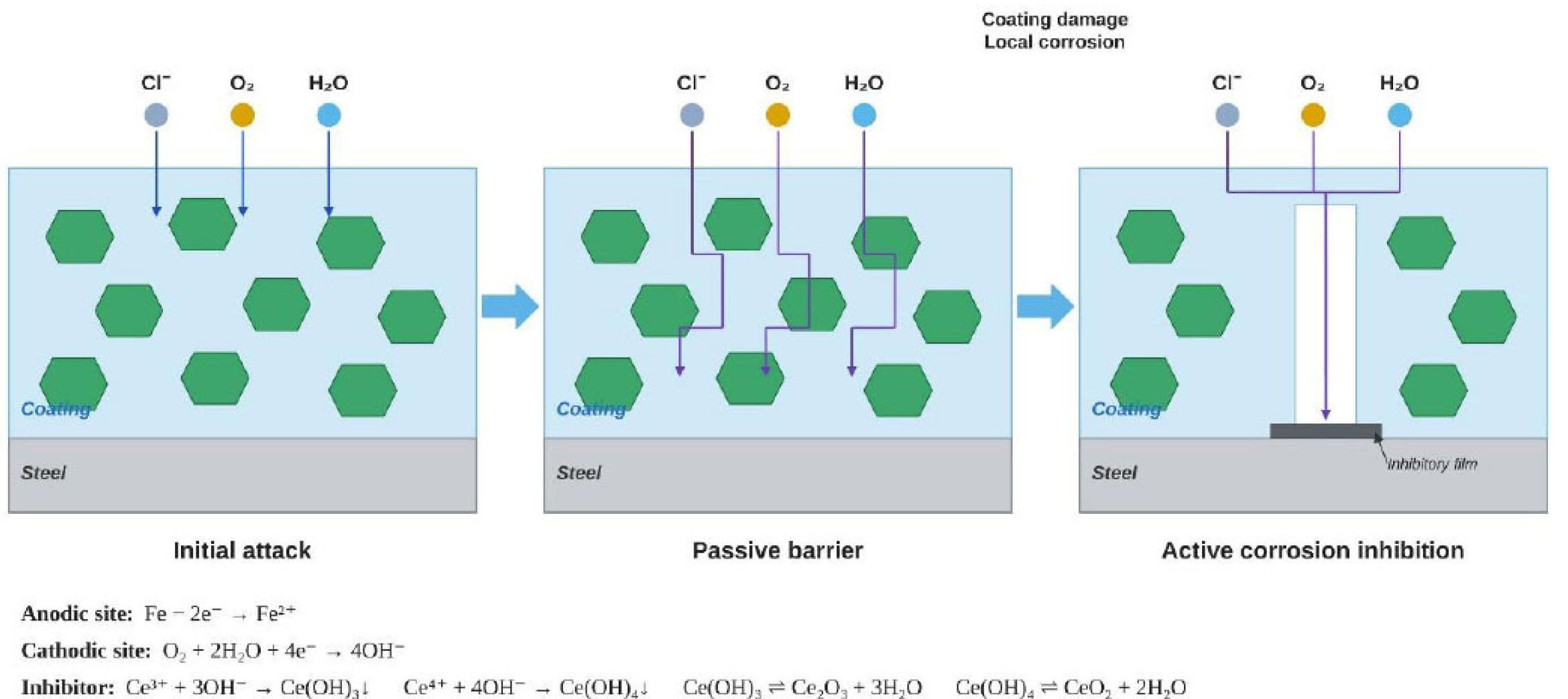
Corrosion protection mechanisms of graphene-modified epoxy coatings: initial attack, passive barrier and active corrosion inhibition (redrawn and adapted from [18]).
While such self-healing and high-temperature-resistant systems illustrate the broader trend toward multifunctional epoxy coatings, the present review focuses specifically on graphene-based modification, which, unlike stimulus-responsive self-healing fillers, targets these same limitations brittleness, moisture ingress, and permeability primarily through physical barrier enhancement (Section 3) rather than active chemical repair, and is examined here as a complementary rather than competing strategy. Additionally, the incorporation of nanofillers and composite reinforcements has been shown to significantly improve barrier properties by reducing permeability, enhancing mechanical strength, and prolonging service life [23]. Advances in high-temperature-resistant epoxy systems, as well as alternative materials such as Calcium Sulfoaluminate (CSA)-based coatings, have further expanded the applicability of protective coatings under extreme thermal conditions [20]. Furthermore, the development of environmentally friendly waterborne epoxy systems integrated with green composites has contributed to reduced Volatile Organic Compound (VOC) emissions while simultaneously improving durability and functional performance, including self-healing capabilities [23]. In summary, although conventional epoxy coatings provide an essential level of corrosion protection for reinforcing steel, their limitations in aggressive environments necessitate the adoption of more advanced and multifunctional coating technologies. Emerging innovations, including self-healing mechanisms, nanostructured fillers, and hybrid composite systems, offer significant improvements in durability, resistance, and sustainability, making them highly promising solutions for long-term infrastructure protection [16]. Beyond chloride ingress, carbonation, temperature and humidity, reinforcing steel in certain structures is also exposed to alternating electromagnetic fields — for example, rebar embedded near coastal substations or magnetic levitation (maglev) infrastructure. Recent work has shown that alternating magnetic fields can measurably accelerate the electrochemical corrosion of rebar, shifting the corrosion potential toward more negative values and increasing the rate of corrosion product formation in proportion to the magnetic field strength. While outside the immediate scope of chloride- and carbonation-driven corrosion addressed in this review, this finding illustrates that the electrochemical environment experienced by embedded reinforcement can be influenced by structure-specific factors beyond the concrete matrix itself, which any protective coating system, including graphene-modified epoxy, must ultimately be robust against.
3. GRAPHENE-MODIFIED EPOXY COATINGS: PROTECTION MECHANISMS
Prior to discussing the individual protection mechanisms, it is useful to distinguish the principal graphene derivatives employed in epoxy nanocomposite coatings, since their surface chemistry governs both their processability and the mechanism by which they contribute to corrosion protection. Pristine graphene consists of sp2-hybridised carbon sheets with minimal oxygen functionality; it offers the highest intrinsic impermeability and electrical conductivity among the four derivatives, but its chemical inertness limits dispersibility in epoxy resin, generally restricting stable, agglomeration-free incorporation to low loadings (typically below 0.5 wt%) unless surfactants or high-shear/ultrasonic processing are used. Graphene Oxide (GO) carries abundant oxygen-containing functional groups (hydroxyl, epoxide, carboxyl) introduced during oxidative exfoliation; these groups improve dispersibility and enable covalent or hydrogen-bonded interaction with the epoxy matrix and with cementitious substrates, at the cost of increased hydrophilicity and reduced electrical conductivity relative to pristine graphene.
Reduced graphene oxide is obtained by partially removing these oxygen groups from GO, restoring a substantial fraction of the sp2 network and hence conductivity and hydrophobicity, while retaining sufficient residual functionality for reasonable dispersion and interfacial bonding; rGO therefore tends to occupy an intermediate position between pristine graphene and GO in terms of barrier performance, hydrophobicity and processability. Graphene Nanoplatelets (GNP), consisting of stacked multilayer graphene sheets with a lower aspect ratio and surface area than single- or few-layer graphene/GO/rGO, are comparatively easier to disperse at higher loadings and are primarily used to increase coating density and physical barrier bulk rather than to maximise tortuosity or interfacial chemical bonding. These differences in surface chemistry, dispersibility, conductivity and interfacial behaviour directly determine which protection mechanism (Sections 3.1–3.3) each derivative is best suited to enhance and are revisited in the dosage-optimisation discussion in Section 6.0.
3.1. Tortuous Diffusion Pathway
The concept of a tortuous diffusion pathway represents a fundamental mechanism underlying the enhanced corrosion resistance observed in graphene-based nanocomposite coatings. From a materials science perspective, this mechanism is primarily associated with graphene's unique two-dimensional lamellar structure, which exhibits exceptional impermeability to gases and liquids. When incorporated into polymer matrices such as epoxy, graphene nanosheets act as highly effective physical barriers that disrupt the direct transport pathways of corrosive species. Instead of diffusing linearly through the coating, aggressive agents such as water molecules, oxygen, and chloride ions are forced to navigate a significantly elongated and convoluted route before reaching the metal substrate [24].
This extended diffusion path effectively delays the onset of corrosion processes and enhances the overall protective performance of the coating system. A critical aspect influencing the efficiency of this mechanism is the alignment and distribution of graphene platelets within the matrix. Ideally, graphene nanosheets are uniformly dispersed and oriented parallel to the substrate surface, forming dense, overlapping layers that maximize the obstruction to mass transport. This platelet alignment increases the effective diffusion length and reduces permeability by creating a maze-like internal structure within the coating [25]. The degree of overlap and stacking between these platelets plays a decisive role in determining the level of barrier enhancement, as well-structured networks provide fewer direct channels for corrosive species to penetrate.
Furthermore, incorporating additional nanostructured materials, such as ceramic platelets or Layered Double Hydroxides (LDH), can intensify the tortuosity of the diffusion pathway. These hybrid systems exhibit synergistic effects, in which multiple barrier-forming components interact to produce superior long-term corrosion resistance compared to single-filler systems [26]. Experimental evidence strongly supports the effectiveness of the tortuous diffusion pathway in improving coating performance. Electrochemical studies, including impedance spectroscopy and corrosion current measurements, consistently demonstrate that graphene-enhanced coatings exhibit significantly lower corrosion current densities and higher impedance values, even after prolonged exposure to aggressive environments [27].
These findings indicate a substantial reduction in ionic transport and corrosion kinetics. Complementary salt spray tests further validate these results, showing minimal corrosion damage and only localized surface defects after extended exposure periods, highlighting the durability of graphene-based coatings under simulated marine conditions [27]. Additionally, microscopic analyses, such as Scanning Electron Microscopy (SEM), reveal that the presence of graphene reduces microstructural defects and increases coating density, both of which contribute to the formation of a more effective tortuous pathway [25].
Despite these advantages, the performance of Graphene-modified epoxy coatings is highly dependent on several key factors. Among these, the quality of graphene dispersion within the polymer matrix is paramount. Uniform dispersion ensures the formation of a continuous and interconnected barrier network, whereas poor dispersion leads to agglomeration of graphene sheets, creating defects and reducing the effectiveness of the tortuous pathway [28]. Functionalization of graphene, particularly in the form of GO or rGO, has been shown to improve compatibility with polymer matrices by introducing functional groups that enhance interfacial bonding and distribution, as shown in Fig. (2a) [29].
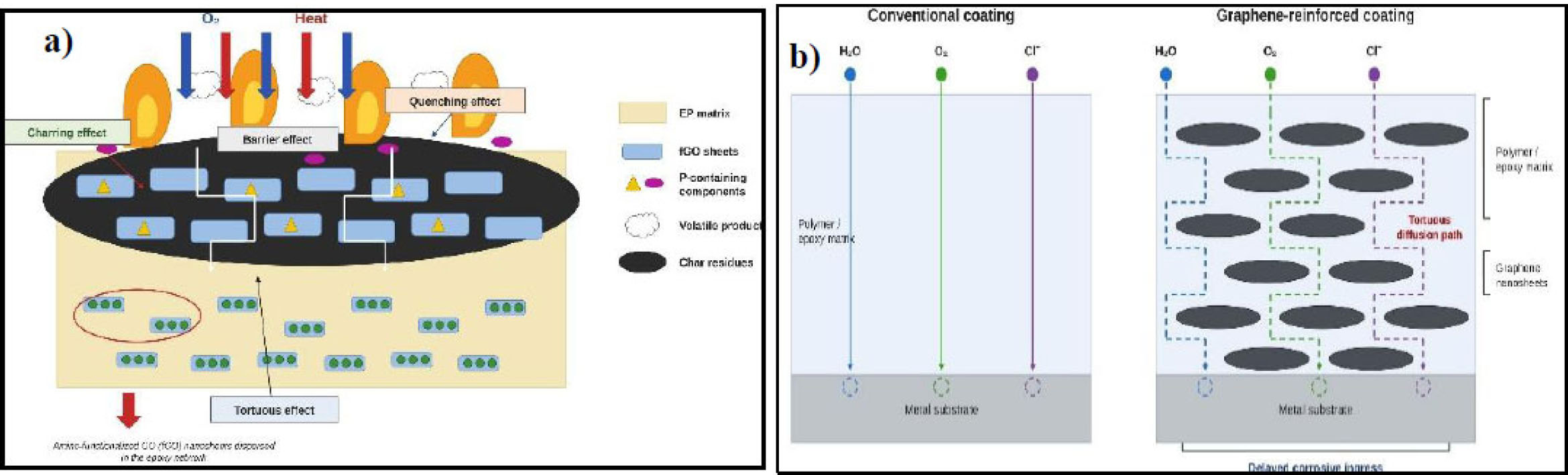
a) Tortuous barrier effect of well-dispersed fGO nanosheets in nanocomposite coatings (redrawn and adapted from [30]); b) Tortuous diffusion path through aligned graphene nanosheets
Moreover, the development of hybrid nanocomposite systems that combine graphene with other fillers offers a promising strategy to further optimize diffusion resistance and mechanical properties through synergistic interactions, as shown in Fig. (2b). In summary, the tortuous diffusion pathway is a critical mechanism that significantly enhances the barrier performance of Graphene-modified epoxy coatings. By increasing the diffusion path length and reducing permeability, graphene-based systems effectively delay the ingress of corrosive species and improve long-term durability. However, achieving optimal performance requires careful control of dispersion, functionalization, and composite design, underscoring the importance of material engineering in the development of next-generation protective coatings.
3.2. Hydrophobic Barrier Effect
The hydrophobic barrier effect in Graphene-modified epoxy coatings plays a critical role in enhancing their protective performance, particularly in corrosive environments. This mechanism is primarily associated with the significant increase in surface hydrophobicity when graphene or its derivatives, such as GO and rGO, are incorporated into polymer matrices. One of the most direct indicators of this improvement is the Water Contact Angle (WCA), which reflects the wettability of the coating surface. Studies have demonstrated that the inclusion of graphene-based materials can dramatically increase WCA values, transforming moderately hydrophilic surfaces into highly hydrophobic or even superhydrophobic ones. For instance, coatings modified with GO and hydrophobic agents have achieved WCA values as high as 161.35°, indicating excellent water repellency [31]. Similarly, graphene/epoxy systems have shown an increase in WCA from approximately 82° for unmodified epoxy to approximately 127°, while graphene/Polyvinylidene Fluoride (PVDF) coatings can reach values of approximately 153.3° [32].
These enhancements are attributed to both the intrinsically low surface energy of graphene and the micro/nano-scale roughness introduced into the coating structure. The increase in hydrophobicity directly contributes to improved resistance against moisture and corrosive media. By reducing water adsorption on the coating surface, graphene nanocomposites effectively limit the transport of aggressive species such as oxygen and chloride ions to the underlying substrate. This is particularly important in preventing the initiation and propagation of corrosion processes. Reduced graphene oxide exhibits superior hydrophobicity compared to GO due to the reduction of oxygen-containing functional groups, thereby enhancing water resistance and barrier efficiency [33].
Consequently, coatings incorporating rGO demonstrate better long-term stability in humid and saline environments. The ability to repel moisture not only delays corrosion initiation but also preserves the structural integrity of the coating over extended exposure periods [31]. In addition to surface hydrophobicity, the barrier performance of Graphene-modified epoxy coatings is further strengthened by the formation of tortuous diffusion pathways within the polymer matrix. Owing to its high aspect ratio and two-dimensional structure, graphene forms elongated, complex pathways that impede the diffusion of water molecules and oxygen through the coating. This significantly reduces permeability and enhances overall corrosion protection [34].
The incorporation of Graphene Nanoplatelets (GNPs) further contributes to the formation of dense and compact passive layers, which act as an additional defense against the ingress of corrosive agents [35]. These combined effects- hydrophobicity and tortuosity synergistically improve the coating’s ability to function as an effective barrier system. From an application standpoint, graphene-based hydrophobic coatings have demonstrated excellent performance across a range of metallic substrates, including aluminum, magnesium, and steel. The integration of functional components such as graphene oxide nanocontainers has been shown to provide not only passive barrier protection but also active corrosion inhibition, particularly in saline environments [31]. Electrochemical Impedance Spectroscopy (EIS) measurements further confirm the enhanced protective behavior of graphene/epoxy coatings, showing increased impedance values that indicate reduced ionic transport and improved coating integrity [34].
Moreover, the superhydrophobic nature of these coatings enables additional functionalities such as self-cleaning and oil–water separation. Coatings with low sliding angles (≤7°) allow water droplets to roll off easily, removing contaminants and maintaining surface cleanliness, which is beneficial for both industrial and environmental applications [36]. Durability is another key advantage of Graphene-modified epoxy coatings. These materials have been shown to retain their hydrophobicity and corrosion resistance even under harsh environmental conditions, including prolonged immersion in saline solutions and exposure to ultraviolet radiation [37]. This long-term stability makes them particularly suitable for demanding applications such as marine infrastructure, pipelines, and protective coatings in outdoor environments.
However, despite these promising properties, several challenges remain. One of the most critical issues is achieving uniform dispersion of graphene within the polymer matrix. Poor dispersion can lead to agglomeration, which reduces effective surface area, disrupts the formation of continuous barrier networks, and ultimately diminishes coating performance [33]. Additionally, concerns related to long-term mechanical durability and large-scale industrial implementation must be addressed to fully realize the potential of graphene-based coatings [38].
In conclusion, the hydrophobic barrier effect in Graphene-modified epoxy coatings is a multifaceted mechanism that combines increased surface water repellency, reduced moisture permeability, and enhanced internal barrier structures to significantly improve corrosion resistance and durability. While the performance benefits are substantial, continued research is required to optimize dispersion techniques, improve mechanical robustness, and ensure scalability for widespread industrial adoption. The schematic in Fig. (3) illustrates the role of various graphene-based materials in improving the corrosion protection performance of nanocomposite coatings. Graphene Oxide (GO) provides moderate hydrophobicity, good polymer compatibility, and oxygen-containing functional groups, which support dispersion and interaction with the coating matrix. Through chemical reduction, GO can be converted into rGO, where the lower oxygen content improves water resistance and enhances barrier efficiency. This makes rGO more effective in limiting the penetration of corrosive species such as water, oxygen, and chloride ions. Alternatively, graphene nanoplatelets can be incorporated directly into coatings, where their high aspect ratio promotes the formation of dense passive layers and improves physical barrier properties. Overall, both rGO and graphene nanoplatelets contribute to corrosion protection by reducing coating permeability, increasing diffusion resistance, and improving long-term durability.
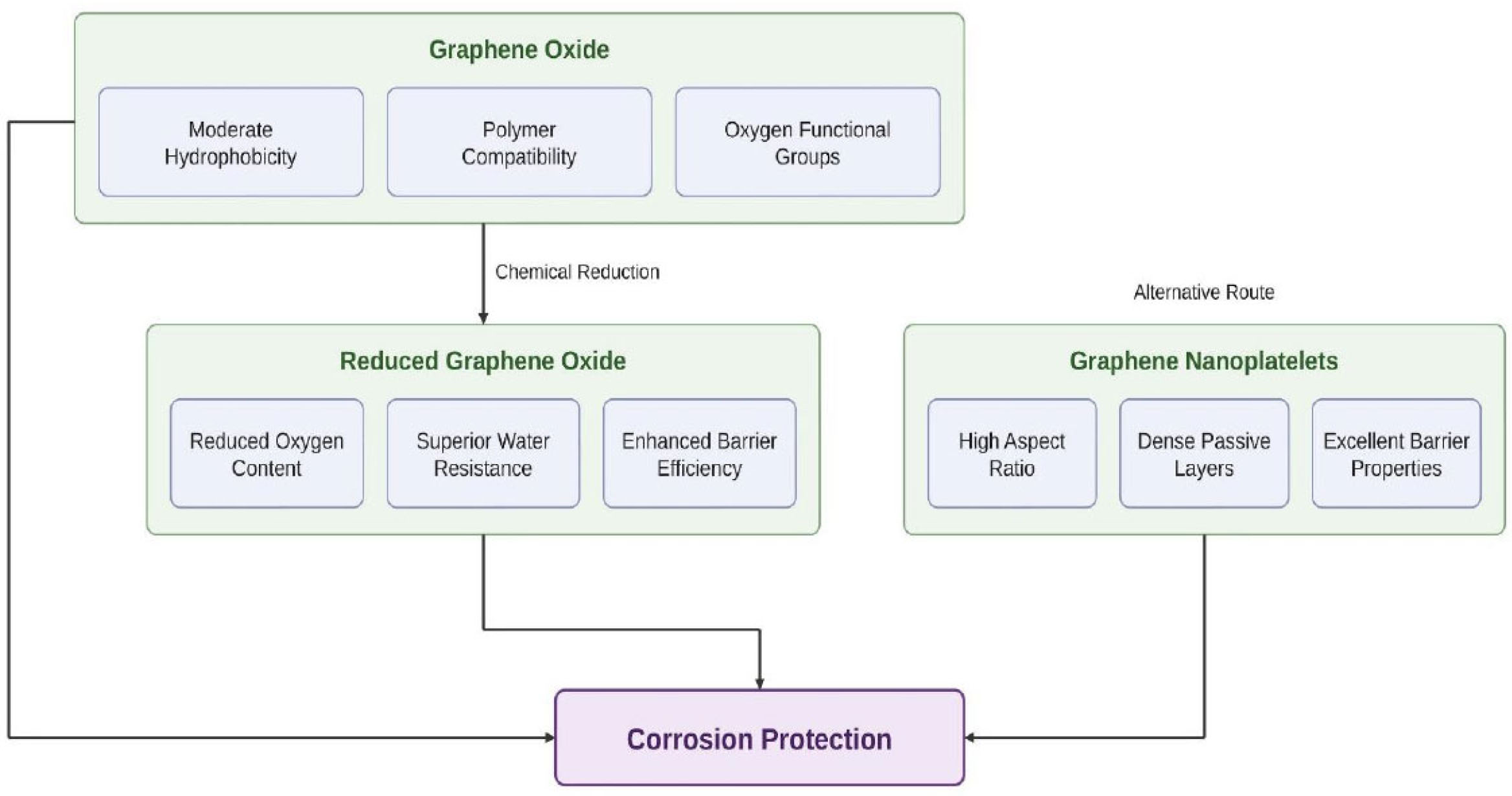
Role of graphene-based materials (GO, rGO and functionalized graphene) in enhancing hydrophobicity and corrosion protection of nanocomposite coatings.
3.3. Dispersion and Interfacial Compatibility
Dispersion and interfacial compatibility are two critical factors that determine the effectiveness of corrosion-protective coatings for steel reinforcement. In nanocomposite coating systems, the protective performance depends not only on the intrinsic properties of the fillers but also on how well these fillers are distributed within the coating matrix and how strongly the coating interacts with the steel surface. Uniformly dispersed fillers, such as rGO nanosheets, can form a continuous barrier network inside the epoxy matrix. This network creates a “maze effect,” where corrosive agents such as water, oxygen, and chloride ions are forced to follow a longer and more complex diffusion pathway before reaching the steel substrate.
As a result, the penetration of aggressive species is delayed, and the coating's corrosion resistance is significantly improved [39]. However, the benefits of nanofillers are highly dependent on their dispersion quality. When the filler content exceeds the optimal level, the particles may aggregate within the coating matrix. This aggregation can create weak points, microvoids, and microcracks, which reduce the compactness of the coating and provide direct pathways for corrosive media to reach the steel surface. For example, coatings containing higher rGO content, particularly at or above 0.5 wt%, have shown reduced protective performance due to filler aggregation and structural defects [40].
Therefore, controlling filler loading is essential to achieve the desired balance between enhanced barrier performance and coating integrity. To improve dispersion, processing methods such as sonication and high-shear mixing are commonly used. These techniques help break down filler agglomerates and promote more uniform distribution of nanomaterials, such as organoclays, within polymer coatings. Improved dispersion through these methods has been associated with stronger adhesion, better mechanical stability, and higher corrosion resistance [41]. Interfacial compatibility between the filler, coating matrix, and steel substrate is equally important for long-term corrosion protection. Strong interfacial bonding improves load transfer, reduces interfacial defects, and prevents coating delamination during exposure to moisture, chloride ions, and mechanical stress. Chemical modification of fillers is one effective strategy to improve compatibility. For instance, amino-functionalized rGO can chemically bond with epoxy resin, resulting in improved filler dispersion, stronger matrix interactions, and improved corrosion resistance [39].
Similarly, silane coupling agents such as γ-aminopropyltriethoxysilane can form self-assembled films on steel surfaces, enhancing adhesion and corrosion resistance at the steel–coating or steel–concrete interface [42, 43]. These chemical interactions improve the continuity of the protective layer and reduce the likelihood of interfacial failure. Hybrid fillers have also been developed to improve both dispersion and interfacial bonding in corrosion-resistant coatings. Materials such as ZnO@Ti3C2TX MXene and polydopamine-bridged glass flakes with graphene oxide (PDA-GFs@GO) have been shown to increase coating compactness, adhesion strength, and long-term stability under aggressive environmental conditions [44, 45]. These hybrid systems provide multiple protective functions, including physical barrier formation, enhanced interfacial adhesion, and reduced diffusion of corrosive species. In addition, the chemical structure of metal-organic framework precursors can influence the interaction between fillers and the coating matrix. For example, acetate-derived ZIF-8 particles exhibit stronger compatibility with the coating system, resulting in improved corrosion protection compared with less compatible filler structures [46].
Several advanced strategies have been proposed to further improve the performance of corrosion coatings for steel reinforcement. Magnetic alignment of fillers, such as Ni-doped rGO, can promote the ordered arrangement of two-dimensional nanosheets within the coating. This alignment improves impermeability by creating a more continuous and parallel barrier structure, thereby increasing resistance to water and ion diffusion [39]. Self-healing coating systems are another promising approach. Coatings containing corrosion inhibitors such as sodium zinc molybdate can repair microcracks or defects during service, helping to maintain coating integrity and continuous protection of the steel substrate [47].
Multifunctional coating systems, including silane/ graphene oxide composites, combine adhesion enhancement, barrier protection, and defect-sealing ability, making them particularly effective for improving corrosion resistance and mechanical durability [42]. Despite these developments, several challenges remain in optimizing dispersion and interfacial compatibility for practical applications. Achieving uniform dispersion and parallel alignment of two-dimensional materials is still difficult, especially at larger production scales [48]. Excessive filler content must also be avoided, as it may cause aggregation, increase coating brittleness, and generate microcracks that reduce corrosion resistance [40]. Future research should focus on developing coating systems that combine strong barrier performance, good adhesion, long-term durability, environmental friendliness, and self-healing or superhydrophobic properties. Such developments would improve the reliability and sustainability of corrosion protection systems for steel reinforcement in aggressive environments [48].
The schematic in Fig. (4) illustrates that the corrosion-protection performance of nanocomposite coatings is mainly controlled by two factors: dispersion quality and interfacial compatibility. Uniformly dispersed nanofillers, such as GO, rGO, or hybrid fillers, form a continuous barrier network that creates tortuous diffusion pathways for H2O, O2, and Cl−, thereby reducing permeability and delaying corrosive ingress. In contrast, poor dispersion causes agglomeration, microvoids, and microcracks, which generate direct diffusion channels and reduce protection efficiency. At the interface, strong filler–matrix interaction and coating–steel adhesion reduce delamination and improve coating integrity. Advanced strategies such as functionalization, hybrid fillers, magnetic alignment, and self-healing systems further enhance long-term corrosion resistance in aggressive environments.
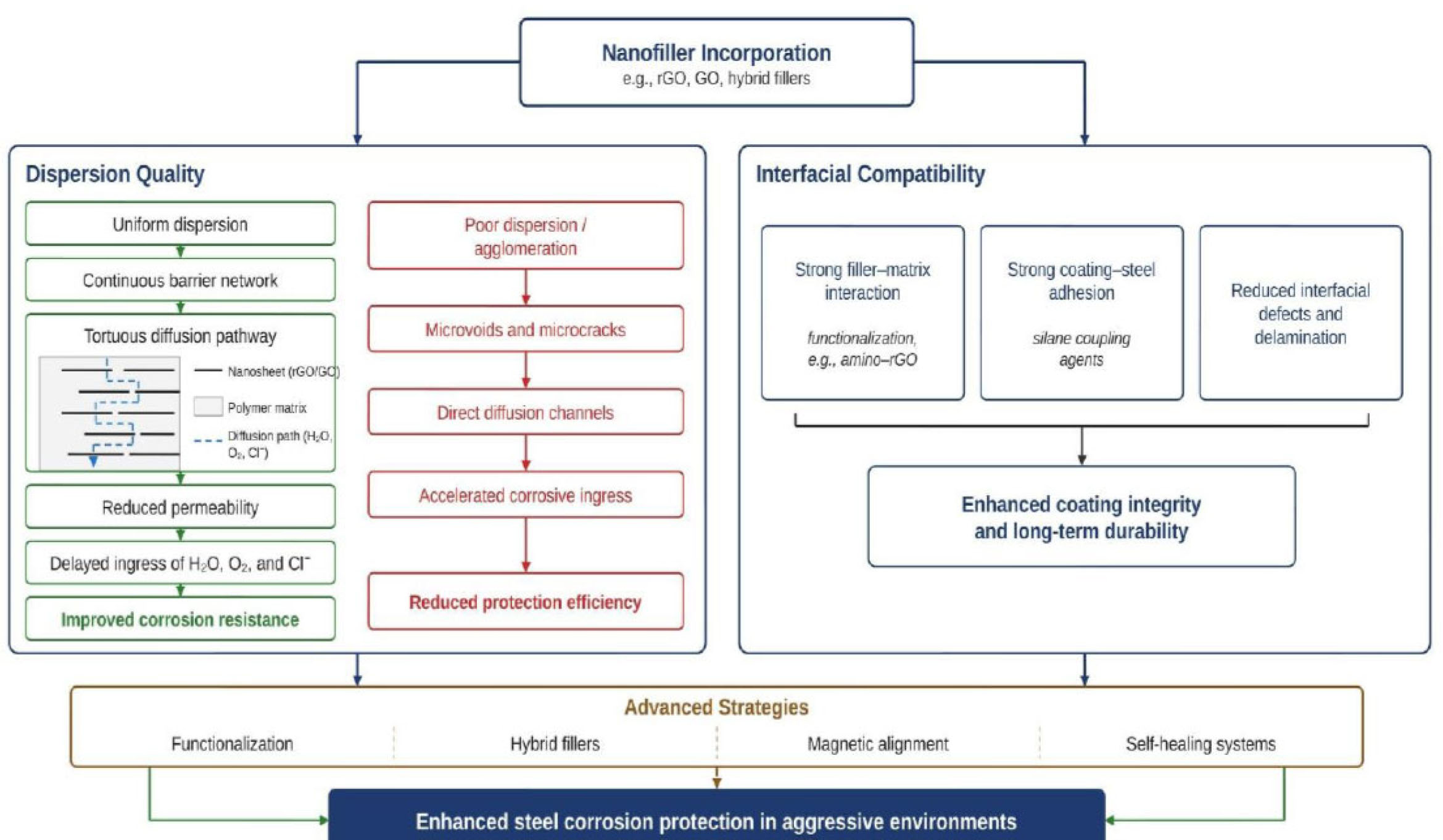
Influence of dispersion quality and interfacial compatibility on the corrosion protection performance of nanocomposite coatings.
The sensitivity of performance to filler dosage and environmental exposure is also evident when graphene oxide is incorporated directly into the concrete matrix rather than only into a surface coating [49]. reported that GO dosed at 0.01–0.05 wt% of cement in fly ash concrete improved microstructure, reduced porosity, and enhanced thermal and moisture resistance, with an optimum dosage of approximately 0.04% producing the greatest compressive strength gain (approximately 16% at 28 days); however, exposure to ambient curing conditions reduced compressive and flexural strength gains relative to fully immersed curing, indicating that GO's benefits in a cementitious environment are similarly dosage- and exposure-sensitive. This finding is relevant to the interfacial compatibility discussion above, since it suggests that the concrete substrate surrounding a graphene-modified epoxy-coated bar may itself respond to graphene-based additives in a similarly dosage-sensitive manner, reinforcing the need for careful, application-specific dosage control rather than assuming transferability of an “optimal” wt% between the coating and substrate systems.
An additional consideration that has received limited attention in the graphene-epoxy coating literature is the electrical conductivity of graphene and rGO. Unlike conventional epoxy, which is intrinsically insulating, graphene-modified epoxy coatings can approach or exceed an electrical percolation threshold at sufficiently high filler loading, particularly when agglomeration creates locally continuous conductive networks. Where such a conductive network extends through the coating thickness, or is exposed at a scratch, pinhole, or thinly coated region, it may provide a partial electronic pathway between the external environment and the steel substrate. Because graphene is electrochemically more noble than steel, a direct or near-direct electronic connection of this kind could, in principle, promote localized or micro-galvanic corrosion activity at the point of contact, analogous to galvanic coupling observed between noble carbon-based fillers and active metal substrates in other coating systems. This risk works against the passive-barrier function that graphene is intended to provide, and implies that dosage and dispersion control (Section 6.0) should be viewed not only as a barrier-optimisation problem but also as a means of keeping the coating below its percolation threshold, so as to minimise the likelihood of conductive defect pathways reaching the steel surface. This aspect currently lacks direct experimental verification for graphene-modified coatings on reinforcing steel and is identified as a research gap in Section 7.0.
The evidence reviewed in Sections 3.1–3.3 indicates that the three protection mechanisms do not contribute equally under all service conditions, and that their relative dominance depends strongly on the specific coating and exposure scenario. In well-dispersed, low-defect coatings subjected to short-term or intermittent wet–dry exposure, the tortuous diffusion pathway is expected to be the dominant mechanism, since the primary barrier to ion transport is geometric obstruction by aligned, overlapping graphene platelets rather than surface wetting behaviour. Under continuous immersion or high-humidity marine exposure, where sustained contact between the coating surface and the aqueous phase controls the rate of water and chloride uptake, the hydrophobic barrier effect becomes increasingly influential, as coatings with higher water contact angles consistently show delayed moisture ingress and slower onset of blistering [31, 32]. Once a coating has aged, been mechanically damaged, or contains microvoids arising from filler agglomeration, dispersion and interfacial compatibility become the controlling factor, since these defects create preferential, low-tortuosity pathways that bypass both the tortuosity and hydrophobicity mechanisms regardless of their intrinsic effectiveness elsewhere in the coating. This suggests that coating design should prioritise different aspects of graphene incorporation depending on the anticipated service environment: tortuosity-focused dispersion for short-term or cyclic exposure, hydrophobicity-focused surface engineering for continuously immersed marine elements, and interfacial-bonding-focused functionalisation for structures expected to experience long-term mechanical or environmental stress.
4. COATING APPLICATION METHODS
4.1. Dip Coating
Dip coating is one of the oldest methods for depositing graphene-based nanocomposite coatings onto metal substrates. The method is dipping the substrate in a suspension of graphene or its derivatives and pulling it out at a speed that provides a wet film that will dry or cure later. The appeal of this technique is its simplicity and its capacity to deliver uniform coverage on small and closely shaped samples. For example, Sivaranjana et al. [50] explored the use of graphene oxide on mild steel, finding that a 50 ppm loading resulted in an impedance modulus of 9361 Ω·cm2 and reduced the corrosion current density to 1.061 µA/cm2 after 24 hours of immersion at 60 °C. Their research indicates that even minimal graphene loadings can lead to substantial improvements. Similarly, Geng et al. [51] examined graphene oxide in silane-based systems, showing that coatings on mild steel reached an impedance modulus of 200 kΩ·cm2 after one hour, significantly higher than the 40 kΩ·cm2 observed for additional additives compromised in the coating's integrity. Zhu et al. [52] reported that GO dip-coated steel achieved a charge transfer resistance of 1.27 × 10⁶ Ω·cm2 and a low corrosion current density of 0.77 µA/cm2, further supporting the effectiveness of graphene oxide in enhancing corrosion resistance with dip coating.
Meanwhile, Braga et al. [53] investigated steel samples that were immersed in prepared sol solutions and withdrawn to form thin coating layers on the surface. After drying and heat treatment, these layers produced ceramic-based protective films as shown in Fig. (5). The findings show that multilayer coatings, especially silica/boehmite (SBxS) and boehmite/silica systems cc can improve corrosion protection by forming a compact barrier between the steel and the corrosive environment. The coating performance depends on the layer arrangement, coating uniformity, and film quality. A well-formed dip-coated layer can reduce the penetration of water, oxygen, and corrosive ions, thereby slowing corrosion. Overall, studies on dip coating highlight the potential of graphene nanocomposites to enhance corrosion protection even at very low concentrations, but they also point out challenges related to scaling up and long-term durability, as the method is less suitable for large surfaces or field applications [50-52].
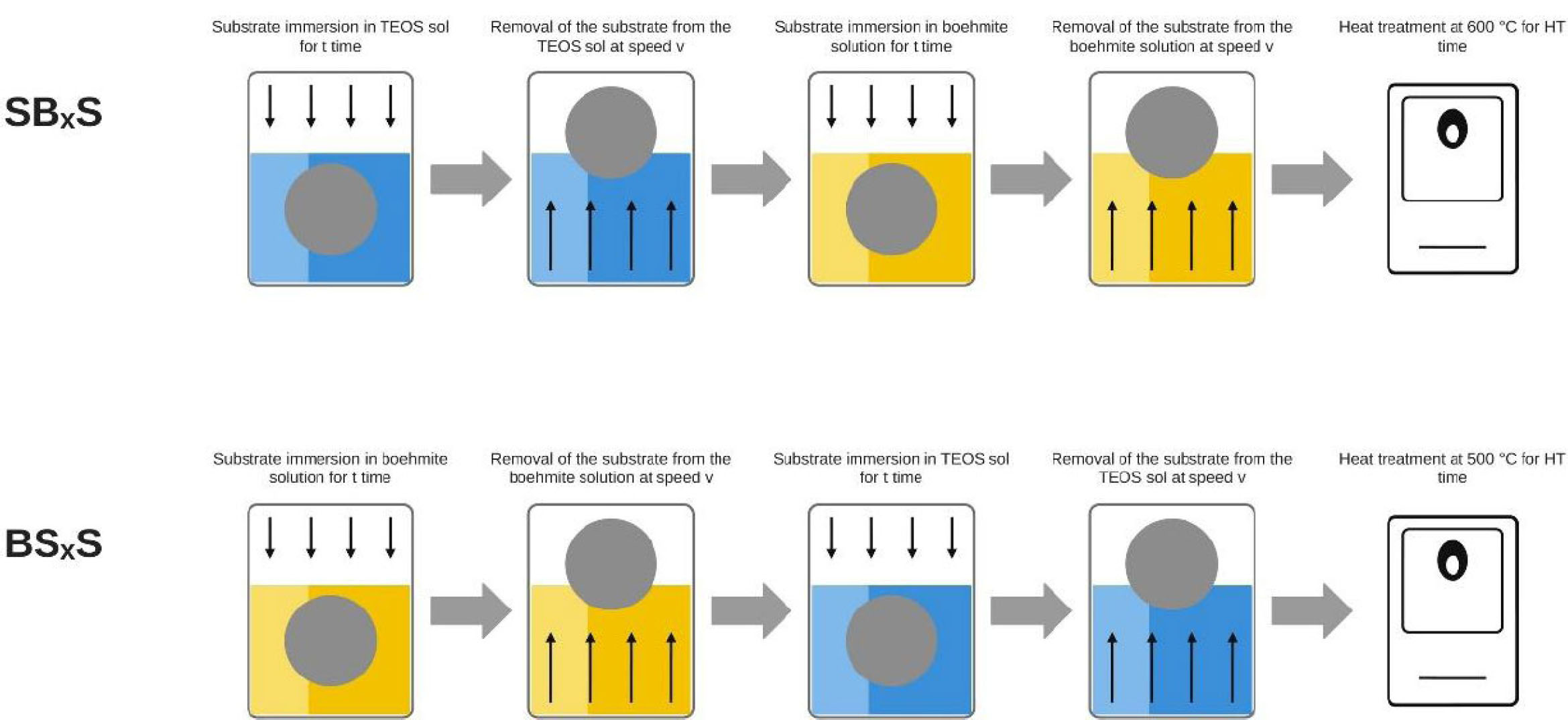
Schematic preparation route of (SBxS) and (BSxS) conversion coatings using a DOE-based design matrix (redrawn and adapted from [53]).
4.2. Spray Coating
Spray coating offers a more adaptable and scalable method for depositing graphene nanocomposites. This technique involves atomizing a liquid suspension of graphene-based materials onto a surface using either compressed air or specialized nozzles. By maintaining dispersion stability, spray coating can produce thicker layers with enhanced uniformity control. Yu et al. [54] created graphene oxide coatings incorporating carbon nanofibers as secondary fillers. When applied to stainless steel, these coatings significantly enhanced corrosion resistance, with the GO-40% composite retaining its structural integrity for up to 168 hours of immersion. Li et al. [55] compared modified graphene oxide coatings on steel using spray methods, achieving coating thicknesses of about 90 μm. Their electrochemical analysis revealed that the coatings maintained an impedance modulus of 4.93 × 10⁸ Ω·cm2 at 0.01 Hz after 300 hours of immersion. Kumari et al. [56] used shroud plasma spraying to apply graphene nanoplatelets onto titanium alloy, resulting in coatings approximately 250 μm thick with impedance values around 9989 Ω, demonstrating their effectiveness against corrosion at low frequencies. Li et al. [55] also showed that cold-sprayed graphene-based coatings on steel rebar achieved corrosion current densities as low as 0.11 nA/cm2 after 13 days, indicating minimal corrosion. In this study, the coating was produced by spraying an epoxy-based mixture containing modified nano-SiO2 and ZnO particles onto the metal surface. The spray process helped form a rough micro/nano surface structure, which is necessary for superhydrophobic behavior. The final coating achieved a very high water contact angle of 167.2° and a low sliding angle of 2.1°, meaning water droplets could easily roll off the surface. This reduces water retention and helps prevent corrosion, as shown in Fig. (6) [57]. These studies suggest that spray techniques can produce thick, highly protective coatings, although they require specialized equipment and optimization to prevent aggregation.
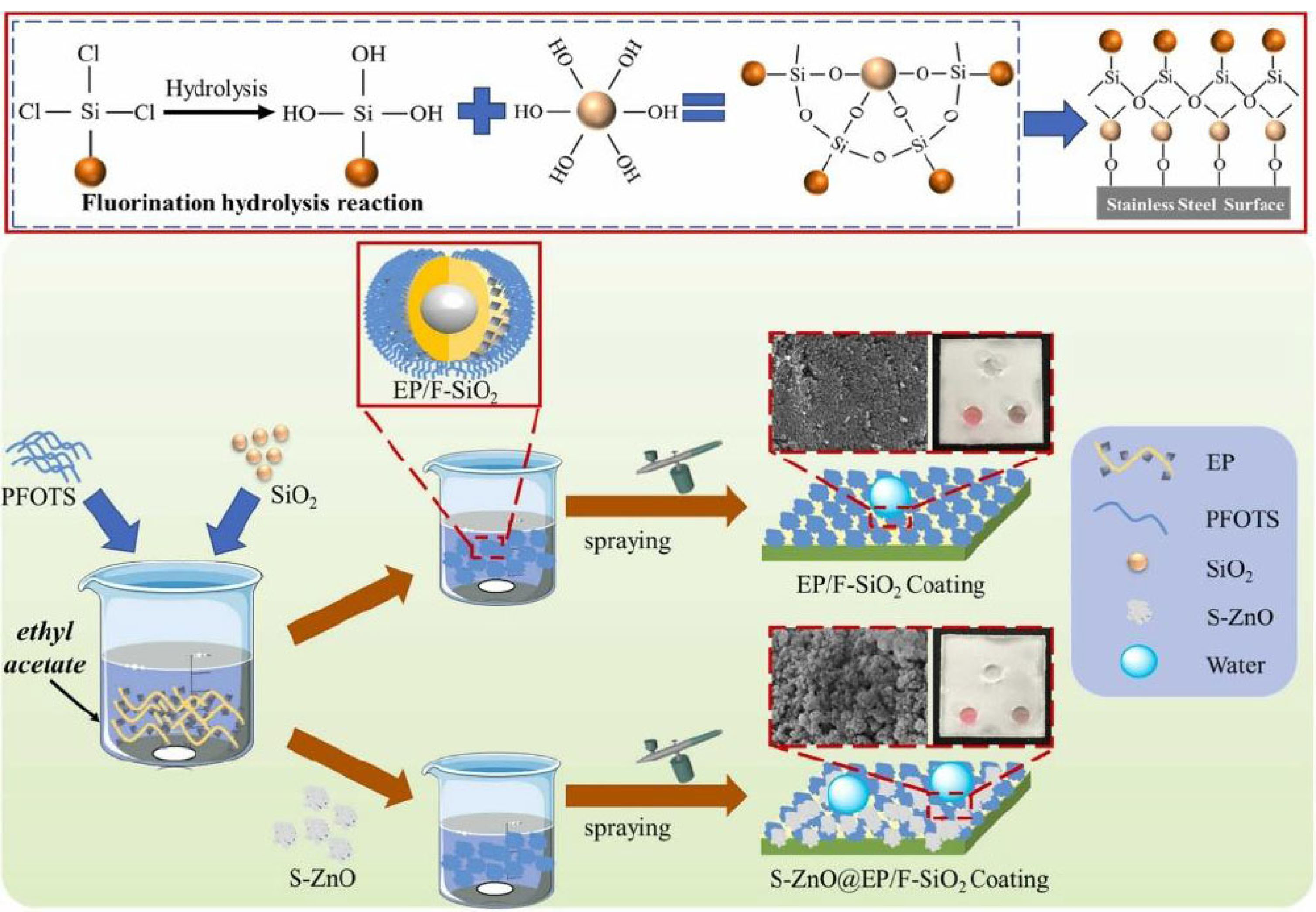
Synthesis pathway for superhydrophobic epoxy resin coatings containing composite nanostructures [57].
4.3. Brush Coating
The success of brush-coated G/EP nanocomposites in providing superior anticorrosion protection can be attributed to several factors. The manual application process allows for better control over the coating's uniformity and thickness, ensuring comprehensive coverage of the substrate. Additionally, the brushing action may contribute to the alignment of graphene particles within the epoxy matrix, potentially enhancing the coating’s barrier properties. The combination of graphene's impermeability and the epoxy's strong adhesion to the substrate creates a formidable defence against corrosive agents. These factors, coupled with the method's cost-effectiveness and ease of application, explain why brush coating remains a popular choice for both research and practical anticorrosion solutions. Ma et al. [58] devised a bipolar graphene system where modified graphene formed both the inner and outer layers on steel using the brush technique. Their brush-coated samples retained an impedance modulus of 5.88 × 10¹⁰ Ω·cm2 after 84 days, with minimal corrosion noted after 3000 hours of immersion. Liu et al. [59] created inorganic zinc-rich coatings infused with graphene and calcium carbonate, applied by brush on steel, and reported a corrosion current density of 1.565 × 10⁻⁵ A/cm2 after seven days, showcasing graphene's capacity to enhance electrochemical stability even in composite formulations. Sharma et al. [10] investigated graphene derivatives incorporated into epoxy on mild steel rebar, achieving coating thicknesses of approximately 270 μm and improved corrosion resistance compared to pure epoxy, although specific impedance values were not provided, as shown in Fig. (7). These studies demonstrate that brush coating offers not only practicality but also exceptional anticorrosion performance, with several results matching or surpassing those achieved through dip and spray methods.
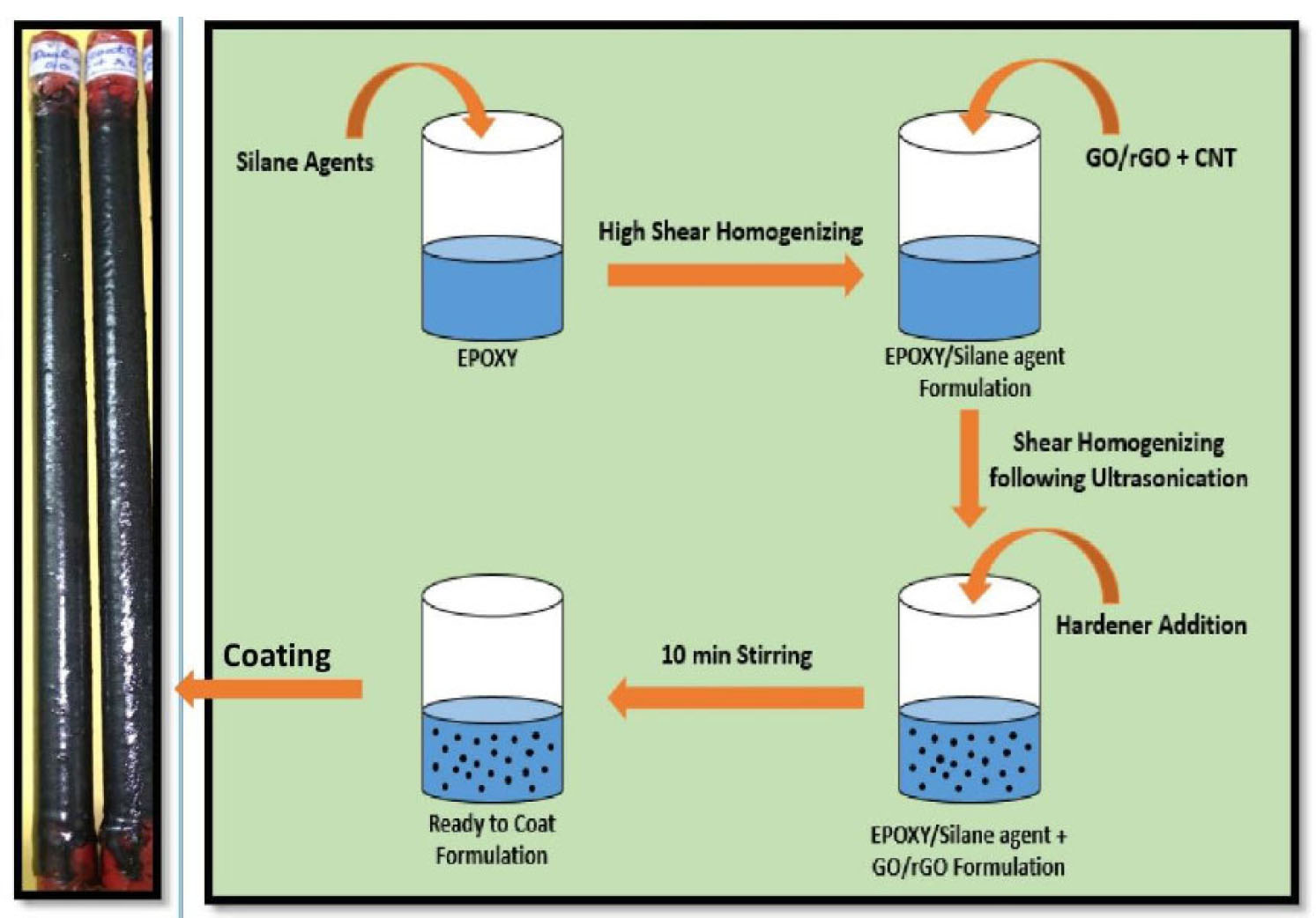
Schematic illustration of the preparation process for rGO/GO-reinforced epoxy coatings [10].
5. PERFORMANCE EVALUATION OF GRAPHENE/ EPOXY COATINGS
It should be noted that several of the studies discussed in this section were conducted on substrates or in electrolyte systems other than reinforcing steel embedded in concrete — for example, mild steel, stainless steel, titanium alloy, magnesium alloy, or zinc-rich/ceramic coating systems tested in NaCl solution rather than simulated concrete pore solution. Such studies are included here on the basis of two criteria: first, where they illustrate a protection mechanism (tortuous diffusion, hydrophobic barrier formation, interfacial/dispersion behaviour) that is expected to operate similarly regardless of the specific substrate or electrolyte, and second, where they provide methodological reference for electrochemical testing (e.g., EIS or PDP protocols) rather than being cited as direct quantitative benchmarks for rebar-in-concrete performance. Because the concrete pore solution is strongly alkaline (typically pH 12.5–13.5) and chemically distinct from the neutral or near-neutral NaCl solutions used in many of these studies, quantitative results such as Rct or Icorr values obtained on non-rebar substrates or in non-concrete electrolytes should not be assumed to transfer directly to the performance of graphene-modified epoxy-coated rebar embedded in concrete, and are presented here as indicative of mechanism rather than as direct evidence of field-relevant performance.
5.1. Electrochemical Impedance Spectroscopy
Electrochemical Impedance Spectroscopy (EIS) is a widely used and reliable technique for evaluating the corrosion resistance of protective coatings, particularly graphene-based nanocomposites. Unlike conventional electrochemical methods that provide limited information, EIS analyzes coating behavior over a range of frequencies, offering a more complete understanding of barrier performance and degradation. Key parameters such as charge transfer resistance (Rct) and low-frequency impedance modulus (|Z|0.01Hz) are commonly used to assess coating effectiveness. In particular, |Z|0.01Hz is highly sensitive to the penetration of chloride ions and is therefore a good indicator of long-term coating durability [35]. Numerous studies confirm that the incorporation of graphene or Graphene Oxide (GO) significantly enhances the impedance performance of epoxy coatings, even at low concentrations. For example, Lei et al. [60] reported that adding 1.5 wt% GO increased the charge-transfer resistance to 1.65 × 10¹⁰ Ω·cm2, indicating a substantial improvement compared to unmodified epoxy. This enhancement is mainly attributed to graphene’s high aspect ratio and impermeable structure, which creates a tortuous diffusion pathway that slows the movement of water, oxygen, and chloride ions toward the metal surface. However, increasing the GO content beyond an optimal level (e.g., >2 wt%) led to particle agglomeration, resulting in coating defects and reduced performance. This highlights that graphene effectiveness depends strongly on proper dispersion and optimal dosage rather than simply increasing filler content [60].
The effectiveness of graphene also varies depending on the coating matrix. In polymer systems such as epoxy, graphene shows strong synergistic effects, leading to very high impedance values (109–1010 Ω·cm2). In contrast [56], reported lower impedance values in ceramic-based coatings (e.g., titanium nitride), even with graphene addition. This suggests that polymer matrices are more effective at distributing graphene sheets and maximizing the tortuous pathway effect, while in ceramic systems graphene mainly improves coating compactness rather than forming a continuous barrier [56]. Hybrid systems, such as GO/CNT composites, have shown improved long-term performance, indicating that combining nanomaterials can further enhance corrosion resistance [10]. Overall, two key factors determine the performance of graphene-based coatings: dispersion quality and optimal filler content. When graphene or GO is well dispersed at low concentrations (typically 0.1–2 wt%), significant improvements in corrosion resistance are achieved. However, excessive loading leads to aggregation, creating defects that reduce coating performance. GO generally provides better long-term stability due to its improved compatibility with polymer matrices, while pristine graphene can deliver strong short-term performance when properly dispersed [51]. In summary, EIS confirms that graphene enhances coating performance primarily by acting as a physical barrier that limits ion transport.
Interpreting and comparing the EIS results summarised in Table 1 requires some methodological caution. Most studies fit the measured impedance spectra to an equivalent electrical circuit representing the coating/steel/electrolyte system, most commonly a Randles-type circuit in which a coating resistance and constant-phase element (representing the non-ideal capacitive behaviour of the porous or heterogeneous coating) are placed in series with a charge-transfer resistance and double-layer constant-phase element representing the steel/electrolyte interface once electrolyte has penetrated the coating. The charge transfer resistance (Rct) therefore reflects the kinetics of the corrosion reaction once ionic pathways have formed, whereas the low-frequency impedance modulus (|Z|0.01Hz) is more commonly used as a global indicator of overall coating barrier quality, since it is less sensitive to the specific circuit model chosen and is strongly influenced by chloride ion penetration [35]. However, the specific circuit topology, the number of constant-phase elements used, and the frequency range fitted differ between studies, and this, combined with differences in electrolyte composition (3.5 wt% NaCl solution versus simulated concrete pore solution), exposure duration (minutes to hundreds of hours), and coating thickness, means that the absolute Rct and |Z|0.01Hz values reported by different authors in Table 1 are not strictly comparable on a like-for-like basis. The values should therefore be read as indicating the direction and approximate order of magnitude of improvement relative to each study's own unmodified-epoxy control, rather than as directly comparable absolute benchmarks across studies. However, its effectiveness depends more on dispersion, interfacial bonding, and formulation design than on graphene content alone, as shown in Table 1.
5.2. Salt Spray Exposure
Salt spray exposure confirms graphene's barrier role by showing delayed rust formation and reduced blistering compared with neat epoxy. Coatings with well-dispersed graphene generally retain better surface integrity because the nanosheets reduce the rate of chloride and moisture transport through the polymer matrix. However, salt spray test results must be interpreted with caution because short exposure periods may not fully reflect long-term reinforced concrete service conditions. While EIS provides detailed information on the electrochemical behavior and barrier properties of coatings, salt spray exposure offers visual and practical evidence of coating durability in chloride-rich environments. When used together, these methods provide a more complete understanding of both the short-term performance and long-term stability of graphene-enhanced coatings [61]. Studies consistently show a strong correlation between EIS results and salt spray performance for graphene-based coatings. For instance, Lei et al. [60] reported that epoxy coatings containing 1.5 wt% GO maintained good structural integrity after prolonged salt spray exposure, exhibiting only minor blistering and limited rust formation.
This behavior was consistent with their EIS findings, in which the coating exhibited a high charge-transfer resistance (Rct), indicating strong resistance to electrolyte penetration. In contrast, unmodified epoxy coatings showed rapid degradation, with a significant decrease in impedance and severe surface corrosion. These results confirm that GO improves the barrier performance of epoxy coatings by creating a more tortuous pathway that delays the ingress of water and chloride ions [60]. A similar trend was observed by Liao et al. [62], who incorporated graphene derived from flash coal into epoxy coatings. After 7 days of salt-spray exposure at 40 °C, the coatings exhibited minimal corrosion and retained most of their surface integrity. Importantly, EIS analysis before and after exposure revealed only minor changes in Nyquist plots, with capacitive behavior largely preserved. This indicates that the graphene network remained stable and continued to resist electrolyte penetration throughout the test period. The study highlights that the effectiveness of graphene-based coatings depends not only on the material type but also on the dispersion quality within the epoxy matrix [62]. Overall, these findings highlight two important points. First, salt spray results strongly support the conclusions drawn from EIS analysis. Coatings with higher impedance values, particularly higher Rct, consistently show better resistance to visible corrosion and slower degradation over time. Second, the type and form of graphene influence coating performance. Graphene oxide generally provides better long-term stability due to its oxygen-containing functional groups, which improve compatibility and bonding with the epoxy matrix. This leads to more uniform dispersion and stronger interfacial adhesion.
However, properly dispersed pristine graphene can also achieve comparable corrosion protection, suggesting that dispersion techniques and processing methods are equally important as chemical modification. In summary, the combination of EIS and salt spray testing clearly demonstrates that graphene significantly enhances both the initial barrier properties and long-term durability of epoxy coatings in aggressive environments. While GO often shows superior performance due to better interaction with polymers, pristine graphene remains a viable alternative when dispersion is well controlled. The salt spray and immersion studies discussed above are informative but are typically limited to continuous or short-cycle exposure over periods of hours to a few weeks, and to a single dominant degradation agent (chloride/moisture) at a time. In actual service, reinforced concrete elements are subjected to combined and sequential degradation processes: wet–dry cycling, prolonged chloride accumulation, carbonation of the concrete cover, ultraviolet exposure at exposed surfaces, seasonal thermal cycling, and mechanical abrasion or damage during construction and service that may interact synergistically rather than additively. For example, wet–dry cycling can accelerate chloride transport relative to continuous immersion, while UV- or thermally-embrittled coatings may be more susceptible to cracking under subsequent mechanical loading. These results confirm that graphene-based materials are effective in extending the service life of protective coatings under chloride exposure conditions, as summarized in Table 2.
5.3. Potentiodynamic Polarization (PDP)
PDP results demonstrate that graphene can suppress both anodic metal dissolution and cathodic oxygen reduction by delaying electrolyte access to the steel/coating interface. The reduction in corrosion current density confirms the protective effect of graphene, while shifts in corrosion potential indicate improved interfacial stability. PDP analysis provides important insight into the corrosion behavior of graphene-modified coatings by evaluating key parameters such as corrosion potential (Ecorr) and corrosion current density (Icorr). These parameters help to understand both the thermodynamic tendency for corrosion and the kinetics of metal dissolution. Nevertheless, PDP results should not be evaluated in isolation because short-term polarization behaviour may differ from long-term immersion performance. Li et al. [55] investigated graphene-modified cold-sprayed zinc coatings applied to reinforcing steel. Although the exact graphene content was not specified, the PDP results showed a clear improvement in corrosion resistance. The Ecorr values shifted towards a more noble potential, while Icorr decreased compared to conventional zinc coatings. This indicates a reduced corrosion rate and enhanced stability of the sacrificial zinc layer. The findings suggest that graphene not only acts as a physical barrier but also modifies interfacial electrochemical behavior, promoting the formation of more stable passivation layers.
However, the absence of complementary Electrochemical Impedance Spectroscopy (EIS) data limits a deeper understanding of long-term performance, especially when compared with polymer-based systems where parameters such as charge transfer resistance (Rct) can be directly correlated with coating durability [55]. A more detailed evaluation was presented by Liu et al. [59], who studied inorganic zinc-rich coatings containing up to 2 wt% graphene. Their results showed a significant reduction in the corrosion current density, reaching 1.565 × 10⁻⁵ A·cm−2 after 7 days of immersion in simulated seawater. This reduction was accompanied by an increase in impedance (734.6 Ω), indicating improved barrier performance. Tafel slope analysis further revealed that graphene contributed to both anodic and cathodic inhibition, suggesting that it effectively slows electron transfer reactions on the metal surface. This dual inhibition mechanism indicates that graphene functions not only as a physical barrier but also as an electrochemical stabilizer, thereby enhancing the protective efficiency of zinc-rich coatings. Importantly, the consistency between PDP and EIS results confirms that an optimal graphene content of around 2 wt% provides a balance between good dispersion and effective corrosion protection [59].
In contrast, Lei et al. [60] examined Graphene Oxide (GO)-modified epoxy coatings and observed a more complex corrosion behavior. Initially, the coatings exhibited low Icorr values and relatively noble Ecorr, confirming the strong barrier effect of GO. However, with prolonged immersion, the corrosion current gradually increased, indicating that aggressive ions eventually penetrated the coating despite high initial resistance. This suggests that while GO improves short-term corrosion resistance through enhanced dispersion and interfacial bonding, its long-term performance may be affected by gradual degradation or the formation of micro-defects within the coating. The results highlight a key limitation: high initial electrochemical performance does not always guarantee sustained long-term protection. Overall, these studies demonstrate that graphene enhances corrosion resistance through multiple mechanisms, including barrier formation, inhibition of electrochemical reactions, and stabilization of protective layers. However, the effectiveness of graphene depends strongly on coating type and formulation. In zinc-rich systems, graphene improves both anodic and cathodic processes, extending the life of sacrificial protection. In epoxy systems, graphene oxide provides strong initial resistance but may face long-term stability challenges. Therefore, optimizing graphene content, dispersion, and compatibility with the coating matrix is essential to achieve both immediate and durable corrosion protection.
6. DOSAGE OPTIMIZATION
The corrosion protection performance of Graphene-modified epoxy coatings is strongly governed by filler dosage, which directly influences dispersion quality, coating microstructure, and barrier efficiency. Based on the collected experimental evidence, graphene does not exhibit a linear improvement in performance with increasing content. Instead, an optimal dosage range exists where the balance between dispersion and barrier formation is maximized. A recurring observation across the studies reviewed above is that a single numerical ‘optimal’ graphene dosage cannot be generalised across systems, and that apparently contradictory findings — for example, 0.5 wt% being reported as optimal in one system [5] yet as excessive and defect-inducing in another [40] — are best explained not by graphene content alone but by the interaction of three variables: (a) the specific graphene derivative and its degree of functionalisation, (b) the dispersion method and formulation used (e.g., sonication, high-shear mixing, chemical functionalisation, or the presence of a co-dispersing filler), and (c) the test/exposure protocol (electrolyte, coating thickness, exposure duration). In the case of Guo et al. [5], 0.5 wt% TiO2-graphene was reported as optimal within a hybrid ceramic–graphene system, where the co-filler is understood to assist dispersion and delay agglomeration relative to a single-filler system.
By contrast, Zhang et al. [40] reported aggregation and reduced protective performance at or above 0.5 wt% rGO in a single-filler epoxy formulation without a co-dispersing agent. The apparent contradiction is therefore resolved once dispersion strategy is accounted for: the numerical dosage threshold at which agglomeration begins to dominate is not fixed, but shifts according to how effectively the specific formulation route delays nanosheet restacking. Accordingly, dosage optimisation should be understood as a formulation-specific exercise — defined jointly by graphene type, dispersion method and target exposure condition — rather than as the identification of a single universal optimal wt% applicable across all graphene-epoxy systems. At low graphene loadings, typically within 0.1–0.5 wt%, nanosheets can be more uniformly dispersed within the epoxy matrix. In this regime, graphene forms discontinuous yet highly effective barrier networks that significantly increase the tortuosity of diffusion pathways for water, oxygen, and chloride ions. Studies on rGO and pristine graphene systems have shown that concentrations as low as ~0.2 wt% can already produce substantial improvements in impermeability, adhesion, and corrosion resistance when dispersion is well controlled [2, 5]. The high aspect ratio and two-dimensional geometry of graphene allow efficient barrier formation even at minimal loading, without significantly increasing coating viscosity or affecting processability. For Graphene Oxide (GO)-based systems, the optimal dosage range is generally higher, typically between 0.4 and 1.5 wt%. This is primarily due to the presence of oxygen-containing functional groups, which enhance compatibility with the epoxy matrix and improve interfacial bonding [7, 8].
Improved dispersion stability enables GO to form more continuous barrier networks compared to pristine graphene at similar loading levels. However, GO also introduces a potential limitation: its hydrophilic functional groups may increase moisture affinity if not properly stabilized or reduced, which can affect long-term corrosion resistance during prolonged exposure. Beyond the optimal range, excessive graphene addition leads to a deterioration of coating performance. This agglomeration-driven decline in performance above an optimal filler loading is not unique to graphene-epoxy systems; a comparable trend has been reported for other nanofiller-modified polymeric coatings. For instance, in nanosilica (nSiO2)-filled room-temperature vulcanized silicone rubber coatings for high-voltage outdoor insulators, a 4 wt.% nSiO2 loading was found to be optimal, producing the highest surface resistivity, hydrophobicity, and permittivity and the greatest reduction in leakage current and harmonic distortion, with performance deteriorating at higher loadings due to filler agglomeration [63]. This cross-material consistency supports the interpretation that an intermediate optimal dosage governed by the balance between barrier/dielectric benefit and agglomeration-induced defects is a general characteristic of nanofiller-modified polymeric coatings rather than a phenomenon specific to graphene. When the filler content exceeds approximately 1.5–2 wt%, graphene nanosheets tend to agglomerate due to strong van der Waals interactions. This aggregation disrupts the uniformity of the coating and creates microstructural defects such as voids, microcracks, and interfacial discontinuities [28, 40].
These defects serve as preferential pathways for electrolyte penetration, thereby reducing the barrier's effectiveness and accelerating corrosion. Experimental observations from EIS and PDP consistently show that impedance decreases and corrosion current density increases when the graphene content exceeds the dispersion threshold. In addition to concentration, the effectiveness of graphene dosage is closely linked to dispersion techniques and coating formulation. Methods such as sonication, high-shear mixing, and chemical functionalization are critical to maintaining nanosheet separation and preventing restacking. Hybrid systems, such as GO/CNT composites, further demonstrate that optimized filler combinations can extend the effective dosage range while improving mechanical integrity and long-term durability [10]. Overall, dosage optimization should not be defined solely based on maximum electrochemical performance (e.g., highest Rct or lowest Icorr). Instead, it must consider multiple factors, including coating morphology, dispersion quality, interfacial bonding, hydrophobicity, mechanical stability, and long-term durability under chloride exposure. While GO offers better dispersion and compatibility, pristine graphene can provide superior barrier performance when properly distributed. Therefore, achieving optimal corrosion protection requires a balanced approach that integrates appropriate graphene type, controlled loading, and effective dispersion strategies. The reported performance trends, dominant protection mechanisms, and key limitations associated with each graphene type and dosage range are summarised in Table 3.
These trade-offs suggest that the choice between pristine graphene, GO, and hybrid/rGO systems should be guided by the specific performance priority and processing constraints of the intended application, rather than by graphene content alone. Pristine graphene is best suited to applications where processing cost is a priority, short- to medium-term barrier/impermeability performance is the primary design driver, and reliable low-shear or ultrasonic dispersion below approximately 0.5 wt% can be achieved and maintained through to application. Graphene oxide is preferable where strong chemical bonding with the epoxy matrix and concrete substrate, longer-term dispersion stability, and compatibility with water-based or low-VOC formulations are prioritised, accepting a moderate increase in moisture affinity as a trade-off. Hybrid systems combining graphene or GO with a second filler (e.g., CNTs, LDHs, or ceramic particles) are preferable when both strong barrier performance and long-term electrochemical stability are required simultaneously, at the cost of more complex formulation, processing, and quality control. This dosage- and application-dependent selection framework, together with the corresponding dosage ranges summarised in Table 3, is offered as practical guidance for coating formulation rather than a single universally optimal graphene type or content.
CONCLUSION
This review highlights the potential of graphene-modified epoxy coatings to serve as advanced passive protection strategies for reinforcing steel in concrete. Compared to conventional epoxy coatings, the presence of graphene in the coatings enhances their resistance to ingress of chloride, oxygen, and moisture due to the formation of tortuous diffusion paths, higher hydrophobicity, lower permeability, and higher coating density. These mechanisms are particularly relevant for reinforced concrete structures subject to harsh marine, coastal, and salt-contaminated environments, where corrosion of embedded steel is a principal cause of premature deterioration. The analysis of electrochemical impedance spectroscopy, salt spray exposure, potentiodynamic polarization, water contact angle measurements, and microscopic examination reveals that the addition of graphene can enhance the coating resistance, decrease the corrosion current density, retard the rust formation, and improve the long-term barrier properties. The addition of graphene does not solely determine the effectiveness of epoxy coatings with graphene. The type of graphene, filler dosage, dispersion quality, interfacial compatibility, coating thickness, application method, curing conditions, and exposure environment collectively govern the final protective performance. Excessive graphene loading leads to agglomeration, micro-defects and loss of coating uniformity, and may also increase the risk of a percolated conductive network reaching the steel substrate, so that dosage must be optimised for each specific formulation rather than maximised (Section 6.0). Moreover, the mechanisms and performance improvements reviewed here are predominantly supported by short-term, coupon-scale laboratory data, and several practical issues specific to reinforced concrete remain unresolved, as discussed below.
A further limitation that warrants explicit discussion concerns the confidence with which the laboratory electrochemical and accelerated exposure results reviewed in this paper (Sections 5.1–5.3) can be translated into expected service-life improvements for reinforced concrete structures in the field. The EIS, salt spray and PDP data compiled here were generated predominantly on coupon-scale specimens under controlled, single-mechanism exposure conditions: continuous or cyclic immersion in NaCl solution or simulated concrete pore solution, fixed temperature, and defect-free coatings over durations ranging from hours to at most a few hundred hours. Reinforced concrete structures in service, by contrast, experience combined and sequential exposure to wetting–drying cycles, carbonation, ultraviolet radiation, thermal fluctuation, mechanical damage and cracking over years to decades. Unlike conventional epoxy-coated rebar, for which standardised test methods and decades of field performance data exist, no quantitative correlation has yet been established between short-term electrochemical metrics such as Rct or Icorr and the long-term corrosion rate or service life of graphene-modified epoxy-coated rebar embedded in concrete. Consequently, the substantial improvements in barrier and electrochemical performance reported in Sections 5.1–5.3 should be interpreted as evidence of mechanistic promise rather than as a validated predictor of field service life, and closing this gap through long-term, full-scale, embedded-rebar testing is identified. Future work should specifically address the following unresolved issues for graphene-modified epoxy coatings applied to reinforcing steel in concrete: (i) the quantitative effect of graphene modification on coating–concrete bond strength and its implications for development length, anchorage design and crack-width control; (ii) the long-term stability of graphene and GO dispersion and interfacial bonding under sustained exposure to the highly alkaline concrete pore solution, as distinct from the neutral or acidic electrolytes used in much of the existing literature; (iii) the risk of conductivity-induced localized or micro-galvanic corrosion at coating defects where a percolated graphene network may contact the steel substrate.
AUTHORS’ CONTRIBUTIONS
The authors confirm their contributions to the paper as follows: N.M.A., W.W.A.Z.: Study conception and design; N.M.A., K.N.K.I.: Data collection; N.M.A., W.W.A.Z., N.A.A., N.M., Z.H.: Analysis and interpretation of results; N.M.A., W.W.A.Z., K.N.K.I.: Draft manuscript preparation. All authors reviewed the results and approved the final version of the manuscript.
LIST OF ABBREVIATIONS
| GO | = Graphene oxide |
| rGO | = Reduced graphene oxide |
| GNP | = Graphene nanoplatelets |
| CNT | = Carbon nanotube |
| LDH | = Layered double hydroxide |
| MOF | = Metal–organic framework |
| EIS | = Electrochemical impedance spectroscopy |
| PDP | = Potentiodynamic polarization |
| WCA | = Water contact angle |
| Rct | = Charge transfer resistance |
| |Z|0.01Hz | = Low-frequency impedance modulus |
| Icorr | = Corrosion current density |
| Ecorr | = Corrosion potential |
| OCP | = Open circuit potential |
| SEM | = Scanning electron microscopy |
| VOC | = Volatile organic compound |
| G/EP | = Graphene/epoxy |
| PVDF | = Polyvinylidene fluoride |
| CSA | = Calcium sulfoaluminate |
| CeO2 | = Cerium oxide |
| ZIF | = Zeolitic imidazolate framework |
| PDA | = Polydopamine |
FUNDING
The authors would like to acknowledge the financial support provided by Universiti Teknologi MARA (UiTM) through the research grant UiTM.800-3/2 GOV (050/2025) for the project entitled “Assessing Jetty Resilience in Malaysia: Evaluating Climate Change Impacts on the Performance of Jetty.”
CONFLICT OF INTEREST
The authors declare that they do not have any commercial or associative interest that represents a conflict of interest in connection with the work submitted.
ACKNOWLEDGEMENTS
The authors express their sincere appreciation to the Faculty of Civil Engineering, Universiti Teknologi MARA, Shah Alam, for the technical, administrative, and research support provided throughout the study.