All published articles of this journal are available on ScienceDirect.

Geotechnical Evaluation of the Influence of Saltwater Intrusion on the Shear Strength Properties of Coastal Soils: A Case Study of Ikot Abasi L.G.A.

Abstract
Introduction/Objective
Saltwater intrusion can significantly alter the geotechnical properties of coastal soils, with implications for infrastructure stability and environmental management. This study investigated the effects of salinity on the shear strength parameters of coastal soils in Ikot Abasi Local Government Area, Nigeria.
Methods
Laboratory tests, including triaxial, direct shear, Atterberg limits, and compaction tests, were conducted on soil samples subjected to different salinity levels. Samples were collected from four locations within the coastal zone and designated as Points A, B, C, and D for identification.
Results
Grain-size analysis classified soils from Points A, B, and C as clayey sand (SC), while Point D was classified as well-graded sand with silt (SW-SM) according to the Unified Soil Classification System (USCS). Accordingly, Points A–C exhibited cohesive behavior, whereas Point D was predominantly non-cohesive. Saltwater intrusion was simulated using NaCl solutions prepared with distilled water. Increasing salinity reduced the liquid limit of Points A–C by 23.2–32.0% and the plastic limit by 7.02–14.6%. Similarly, OMC decreased while MDD increased with increasing salt concentration. Cohesion increased progressively with salinity, from 34% to 48% at Point A, 42% to 58% at Point B, and 17.3% to 26.0% at Point C, whereas the corresponding variations in the angle of internal friction (ϕ) were nonlinear. At Point D, ϕ decreased progressively from 31.34° to 24.86° with increasing salinity.
Discussion
Increasing salinity reduced the liquid limit and the plasticity index of soils from Points A, B, and C, whereas Point D remained non-plastic. The reduction in PI indicates a narrower plasticity range and reduced susceptibility to shrink–swell behavior. The observed decrease in OMC and increase in MDD with increased salinity may be associated with salinity-induced changes in clay-particle interaction and soil fabric. Triaxial tests further showed that cohesion increased with salinity for the cohesive soils at Points A, B, and C, although the corresponding variations in friction angle (ϕ) were nonlinear. In contrast, Point D exhibited a progressive decline in ϕ, with a reduction of approximately 6.48° between distilled water and 15% saline water. The failure-envelope intercepts (−0.10 to +0.04 kPa) were close to zero, indicating negligible cohesion and confirming that shear strength at Point D was governed mainly by friction.
Conclusion
The results of this study demonstrate that increasing salinity was associated with the changes observed in the shear strength parameters and mechanical behavior of coastal soils. These findings highlight the need to account for salinity-induced changes in geotechnical design and assessment of coastal infrastructure.
1. INTRODUCTION
Ikot Abasi is a coastal region in Nigeria, located between latitudes 4.500278°–4.666944° N and longitudes 7.500278°–7.650278° E. It lies within the transition zone between the mangrove swamp and rainforest ecosystems of the eastern Niger Delta, with approximately 20%–30% of its total area covered by water. The terrain is relatively flat and comprises alluvial plains, rolling sandy plains, and beach-ridge sands as the major physiographic units [1]. According to the geological map published by the Nigerian Geological Survey Agency (2006), the geology of Ikot Abasi Local Government Area is predominantly composed of Coastal Plain Sands, which are associated with prolific groundwater resources but generally low aquifer protective capacity. Groundwater in the area has been reported to be affected by saltwater intrusion and elevated concentrations of major ions exceeding World Health Organization (WHO) recommended limits, with Na+ and Cl− being the predominant dissolved ions [2, 3]. The study area lies within the Coastal Plain Sands of the Niger Delta and is primarily associated with the Benin Formation, which comprises unconsolidated to poorly consolidated sands interbedded with clay lenses and shale units. Previous mineralogical investigations of sediments from Akwa Ibom State and the adjacent Niger Delta have consistently identified kaolinite as the dominant clay mineral, with subordinate illite and varying proportions of smectite, including montmorillonite [4, 5].
1.1. Background and Challenges of Coastal Regions
Continued global population growth has increased the demand for land to support agricultural and infrastructural development, thereby placing greater pressure on coastal and other marginal terrains. However, coastal and swampy environments often exhibit unfavorable engineering properties, including high compressibility, low bearing capacity, high plasticity, low shear strength, and low hydraulic conductivity [6]. Climate change-induced sea-level rise has further intensified environmental pressures in coastal regions, which are commonly characterized by Quaternary sediments, soft marine clays, low-lying plains, extensive wetlands, river networks, and shallow groundwater tables. These conditions increase the vulnerability of coastal environments to flooding and saltwater intrusion, thereby altering the mechanical and physicochemical properties of soils and contributing to declining agricultural productivity [7, 8].
1.2. Saltwater Intrusion and its Effects on Soil Properties
Owing to their proximity to the coast, coastal soils and freshwater aquifers are susceptible to saltwater intrusion and subsequent salinization. Saline soils, typically characterized by elevated soluble salt contents, may exhibit undesirable engineering characteristics, including swelling, corrosion, collapsibility, and settlement, which can adversely affect the performance of infrastructure [9, 10]. Saltwater intrusion is a global environmental and geotechnical challenge driven by sea-level rise, groundwater over-extraction, and anthropogenic activities that disrupt natural hydrological balances. Its effects extend beyond ecological degradation to alterations in soil properties that are critical to agricultural productivity, infrastructure performance, and environmental sustainability [11, 12].
Saltwater is characterized by a high concentration of dissolved salts and occurs naturally in oceans and seas or can be artificially prepared by adding salts to freshwater. Salinity is commonly expressed in grams per litre (g/L) or parts per million (ppm), with seawater having an average salinity of approximately 35 g/L [13]. The six most abundant ions in seawater are chloride (Cl−), sodium (Na+), sulfate (SO42−), magnesium (Mg2+), calcium (Ca2+), and potassium (K+) [14, 15]. For civil and geotechnical engineering applications, soil strength is a critical mechanical property; therefore, factors such as salinity that can modify shear-strength parameters require careful consideration. In geotechnical structures such as embankments, road subgrades, and retaining walls, the dissolved salt content of saline soils used as fill material can significantly influence structural safety and performance [16]. Salinity can modify soil composition, hydraulic conductivity, compression index, water-retention characteristics, fabric, and shear strength, thereby affecting its load-bearing capacity and stability [17].
A previous study [18] reported that Atlantic Ocean water can act as an effective soil-stabilizing agent based on comparisons of laboratory results obtained from different soil mixtures prepared with Atlantic Ocean water and freshwater. The results indicated that the presence of saltwater can significantly modify soil mechanical properties, producing increases in the friction angle, compaction characteristics, and unconfined compressive strength relative to those obtained using freshwater. Similarly, sodium chloride has been investigated as a chemical stabilizing agent for mitigating undesirable swelling and modifying the index properties of expansive soils [19]. The addition of chloride salts to expansive soils with high swelling potential has been reported to reduce the liquid and plastic limits and free-swell index, while increasing the maximum dry density and improving compaction characteristics with increasing salt content [20, 21]. Conversely, other studies have reported that the dispersive effects of salinity can destabilize clay particles and reduce the liquid limit, plasticity index, cohesion, and angle of internal friction, thereby diminishing the load-bearing capacity of soils [22, 23].
Salinity-induced changes in shear strength can have significant implications for the stability and performance of geotechnical structures in coastal environments. These effects may be further influenced by seasonal variations in groundwater salinity and tidal fluctuations, which can contribute to temporal changes in soil strength [24]. Salinity can also modify soil aggregate-size distribution through its influence on particle flocculation, potentially enhancing the aggregation of fine particles such as silt and clay [25]. In addition Ouyang et al., investigated the effect of salt concentration on the cohesion behavior of quartz substrates at the nanoscale and reported that salt ions can weaken quartz wettability [26].
1.3. Problem Statement
Ikot Abasi is experiencing rapid industrialization, urbanization, population growth, and infrastructure development, creating an increasing need to understand the effects of saltwater intrusion on soil shear-strength properties. These properties are critical geotechnical parameters governing the stability and performance of infrastructure constructed on coastal soils. However, the geotechnical implications of saltwater intrusion in Ikot Abasi, Nigeria, remain insufficiently understood because of limited research addressing the region's distinctive geological and hydrogeological conditions, inadequate data on the shear-strength characteristics of its coastal soils, and the absence of region-specific mitigation strategies. Furthermore, the effects of seasonal fluctuations in groundwater salinity and tidal variations on the engineering behavior of soils in Ikot Abasi have not been adequately established. Therefore, this study investigates the effects of saltwater intrusion on the shear-strength parameters of coastal soils through laboratory testing of field-collected soil samples subjected to different salinity conditions. The study aims to provide insights into the geotechnical implications of saltwater intrusion for infrastructure constructed on coastal soils, with particular focus on soils within the Federal University of Technology, Ikot Abasi, and its surrounding areas, thereby contributing to more sustainable coastal infrastructure development.
2. MATERIALS AND METHODS
2.1. Study Area
The study was conducted within the premises of the Federal University of Technology, Ikot Abasi, located in Ikot Abasi Local Government Area, Akwa Ibom State, Nigeria. The study area is relatively flat and low-lying, is prone to seasonal flooding, and exhibits low infiltration rates. The soils are predominantly sandy soils with varying clay and silt fractions.
2.2. Soil Sampling
Soil samples were collected from four sampling points within the university premises, with adjacent points separated by at least 500 m. At each location, samples were collected at a depth of 1.5 m below the ground surface after removing surface vegetation. This depth was selected because it represents the anticipated active/stress-influenced zone of shallow foundations, and observed site conditions. Samples collected from the four locations were designated Points A, B, C, and D for identification.
2.3. Laboratory Tests
The following laboratory tests were conducted to characterize the physical and shear-strength properties of the sampled soils:
- Natural Moisture Content and Bulk Density: Natural moisture content and bulk density were determined to characterize the in-situ condition of the soils in accordance with ASTM D2216 and ASTM D7263, respectively.
- Grain-Size Analysis: Grain-size distribution was determined using sieve analysis and hydrometer analysis in accordance with ASTM D6913 and ASTM D7928, respectively.
- Atterberg Limits: Liquid limit, plastic limit, and plasticity index were determined in accordance with ASTM D4318 and AASHTO T89/T90.
- Compaction Test: Maximum Dry Density (MDD) and Optimum Moisture Content (OMC) were determined using the standard Proctor compaction test in accordance with ASTM D698.
- Triaxial Compression Test: Consolidated undrained (CU) triaxial compression tests were conducted in accordance with ASTM D4767 and AASHTO T297 under freshwater and saline conditions to evaluate the effects of salinity on the shear-strength parameters of the soils.
- Direct Shear Test: Direct shear tests were conducted in accordance with AASHTO T236 to evaluate the shear strength of the soil along a predefined failure plane under controlled normal stress.
2.4. Materials
The materials used in the study comprised soil samples collected from the study area, sodium chloride (NaCl) for simulating saltwater intrusion, and distilled water for preparing saline solutions. The laboratory equipment included a sieve set, hydrometer, Atterberg limits apparatus, compaction mould, triaxial testing apparatus, and direct shear apparatus.
2.5. Method
The methodology used involved both laboratory tests and data analysis to evaluate the influence of saltwater intrusion on the shear-strength properties of coastal soils. All tests were conducted in accordance with relevant ASTM and AASHTO standards, and the results are presented clearly and systematically.
Laboratory tests were designed to simulate the effect of saltwater intrusion on the soil samples. Saline solutions were prepared by dissolving NaCl in distilled water at concentrations of 5%, 10%, and 15% by dry weight of soil. These solutions were mixed with the soil samples, and the resulting changes in shear-strength properties were compared with those obtained using distilled water only (0% salinity). Clay activity was determined using the clay fraction (< 2 μm) obtained from hydrometer analysis. Soil classification was carried out in accordance with ASTM D2487.
The Consolidated Undrained (CU) compression tests were conducted to evaluate the shear-strength characteristics of the soil specimens under undrained loading conditions following consolidation. Three specimens were tested at each salinity level under confining pressures of 70, 140, and 210 kPa. The specimens were treated with saline solutions corresponding to 0%, 5%, 10%, and 15% salt content by dry weight of soil and were allowed to cure and equilibrate prior to testing. Failure was defined as the peak deviator stress observed during shearing.
The minor principal stress (σ3) and peak deviator stress were used to calculate the major principal stress (σ1), using Eq. (1).
 ...(1)
 ...(2)
 ...(3)
 ...(4)
σ1 = Major Principal stress (kPa)
σ3 = Minor Principal stress or confining pressure (kPa)
ɽ = Shear stress at failure (kPa)
φ = Angle of internal friction (o)
c = Cohesion (kPa)
Laboratory test data were analyzed, and the results presented in tables, graphs, charts, and figures. The implications of the findings are discussed in detail.
2.6. Quality Control
Relevant ASTM and AASHTO testing procedures were meticulously followed to ensure the accuracy, reliability, and reproducibility of the results. The data obtained were subsequently analyzed to evaluate the influence of saltwater intrusion on the shear-strength properties of the coastal soils.
3. RESULTS AND DISCUSSION
3.1. Saltwater
The saline solutions used in this study were prepared by dissolving sodium chloride (NaCl) in distilled water. Salt concentrations of 5%, 10%, and 15% were adopted and expressed as percentages of the dry weight of the soil.
3.2. Engineering and Physicochemical Properties of the Soils
A summary of the engineering properties of the natural soils is presented in Table 1, while the grain-size distribution curves are shown in Fig. (1). Salinity and pH tests were conducted on the soil samples to determine their chemical characteristics in the natural state, and the results are presented in Table 2.
| S/N | Soil Property | Point A | Point B | Point C | Point D |
|---|---|---|---|---|---|
| 1 | Natural water Moisture, % | 9.2 | 4.8 | 4.3 | 1.0 |
| 2 | Bulk Density (g/cm3) | 1.77 | 1.85 | 1.82 | 2.03 |
| 3 | Liquid Limit % | 29.3 | 27.8 | 36.2 | Non-Plastic |
| 4 | Plastic Limit % | 17.1 | 14.3 | 23.3 | Non-Plastic |
| 5 | Plasticity Index % | 12.2 | 13.5 | 12.9 | Non-Plastic |
| 6 | Linear Shrinkage | 8.5 | 12.1 | 7.9 | Non-Plastic |
| 7 | Maximum Dry Density (g/cm3) | 1.51 | 1.60 | 1.61 | 1.70 |
| 8 | Optimum Moisture Content (%) | 20.8 | 15.1 | 15.0 | 15.0 |
| 10 | Bulk Unit Weight (KN/m3) | 17.4 | 18.1 | 17.9 | 19.9 |
| 11 | Sand Content % | 60.2 | 72.8 | 61.4 | 88.6 |
| 12 | Silt % | 23.4 | 11.97 | 18.28 | 8.96 |
| 13 | Clay Content % | 16.4 | 15.23 | 20.32 | 2.44 |
| 14 | Activity (A) | 0.732 | 0.886 | 0.635 | N/A |
| 15 | AASHTO | A-6(1) | A-2-6(0) | A-6(1) | A-2-4 |
| 16 | USCS | SC | SC | SC | SW-SM |
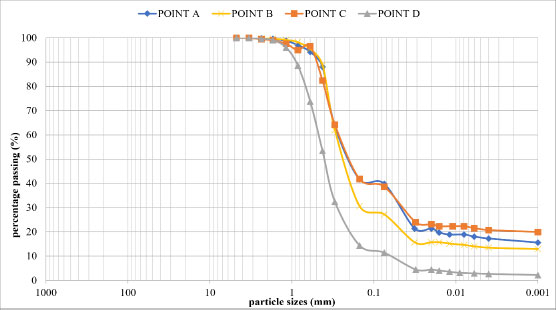
Particle size distribution curve of soil samples.
| S/N | Location | pH | Turbidity | Salinity | Chloride | Sulphate |
|---|---|---|---|---|---|---|
| 1 | Point A | 7.8 | 93.5 NTU | 0.084 (ppt) | 0.3 ppm | 0.01% |
| 2 | Point B | 7.7 | 88.7 NTU | 0.102 (ppt) | 0.4 ppm | 0.01% |
| 3 | Point C | 6.7 | 59.7 NTU | 0.120 (ppt) | 0.5 ppm | 0.02% |
| 4 | Point D | 8.9 | 59.7 NTU | 0.102 (ppt) | 0.4 ppm | 0.02% |
The results indicate relatively low salinity, chloride, and sulphate concentrations within the soils. Nevertheless, the physicochemical characteristics suggest that the soils are typical of a coastal or deltaic environment and may be influenced by seawater intrusion or groundwater interactions.
Furthermore, Point A recorded a high turbidity value of 93.5 NTU, which may be attributed to poor drainage conditions or the presence of fine-grained particles such as silt and clay. Elevated turbidity may reduce soil permeability and increase susceptibility to swelling, shrinkage, and strength loss under wet conditions.
3.3. Atterberg Limits
Table 3 and Figs. (2-4) present the results of the Atterberg limits test conducted on the soil samples using both distilled water and saline solutions. The liquid limits of the soil at point A, B, and C were observed to decrease with increasing salt concentration, with percentage reductions ranging from 23.2% to 32.0%. Similarly, the percentage reduction for the plastic limit ranged from 7.02% to 14.6%. These results indicate that the effect of salinity on plastic limits is less pronounced than its effect on the liquid limits. According to Li et al. [24], this difference may be attributed to the greater influence of salinity at higher moisture contents. As the liquid limits decrease with increasing salinity, plasticity index is reduced as well.
| Soil Property | Distilled Water | Saline Water 5% |
Saline Water 10% |
Saline Water 15% |
|
|---|---|---|---|---|---|
| Point A | Liquid Limit (%) | 29.3 | 20.2 | 21 | 20 |
| Plastic Limit (%) | 17.1 | 16 | 16 | 15.9 | |
| Plasticity Index (%) | 12.2 | 4.2 | 5 | 4.1 | |
| Point B | Liquid Limit (%) | 27.8 | 22 | 20.03 | 18.9 |
| Plastic Limit (%) | 14.3 | 14 | 13.5 | 12.6 | |
| Plasticity Index (%) | 13.5 | 8 | 6.53 | 6.3 | |
| Point C | Liquid Limit (%) | 36.2 | 33.9 | 30.9 | 27.8 |
| Plastic Limit (%) | 23.3 | 22.1 | 20.9 | 19.9 | |
| Plasticity Index (%) | 12.9 | 11.8 | 10 | 7.9 | |
| Point D | Liquid Limit (%) | Non-plastic | - | - | - |
| Plastic Limit (%) | Non-plastic | - | - | - | |
| Plasticity Index (%) | Non-plastic | - | - | - |
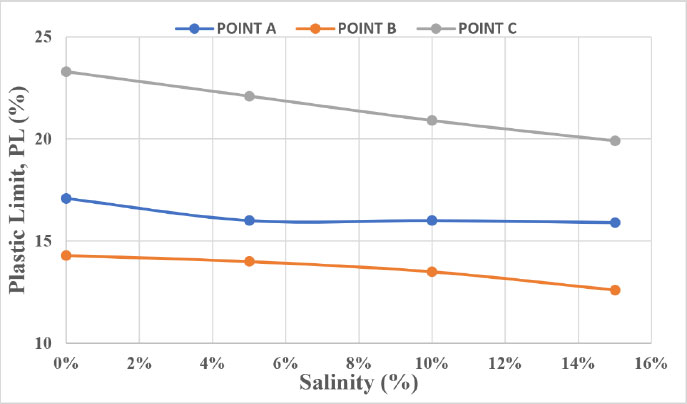
Variation of plastic limits with salinity.
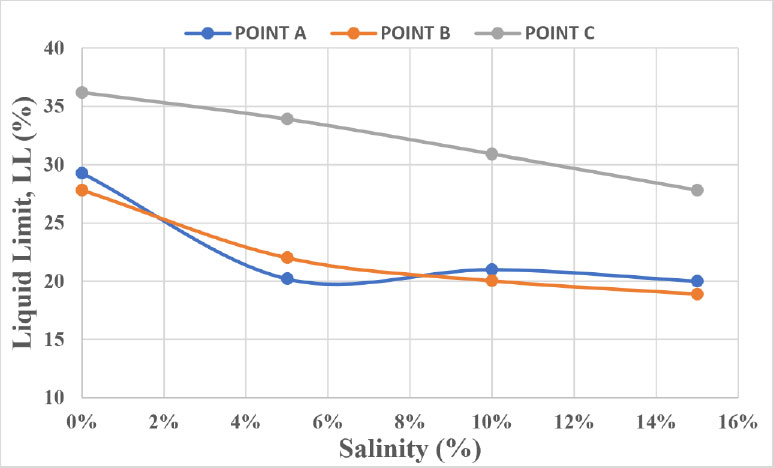
Variation of liquid limits with salinity.
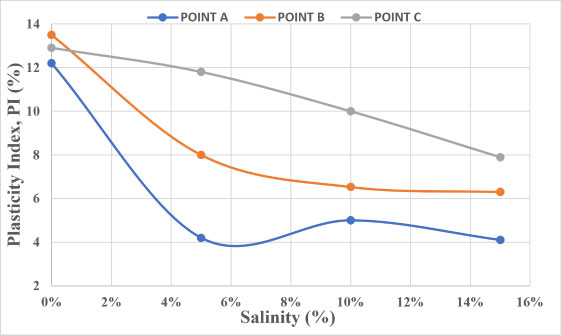
Variation of plasticity index with salinity.
In a related study [26], attributed this reduction to the replacement of water molecules within the soil structure by salt ions, resulting in a decrease in the thickness of the diffuse double-layer surrounding clay particles. Similarly Abu and El-Aal et al. [21], explained that free ions such as Na+ and K+ present in saline water replace the cations within the hydrous layer surrounding clay particles, thereby reducing the net electrical charge.
The reduction observed in this study may therefore be attributed to the high ionic concentration of the saline solution, which compresses the diffuse double layer and reduces the water-absorption capacity of the clay particles. Consequently, the liquid limit decreases as salt concentration increases. The resulting reduction in the plasticity index indicates a narrower plastic range and lower susceptibility to shrink–swell behavior. While this may be beneficial for foundation stability and bearing capacity, it may also result in reduced soil cohesion.
The soil at Point D was classified as non-plastic, exhibiting a plasticity index (PI) of zero and an undefined plastic limit (PL).
3.4. Maximum Dry Density and Optimum Moisture Content
Compaction tests were performed on each soil sample at varying salt concentrations (0%, 5%, 10%, and 15%). The results presented in Table 4 indicate that Optimum Moisture Content (OMC) decreased with increasing salt concentration, whereas the Maximum Dry Density (MDD) increased. The influence of salinity was most pronounced in the soil from point A, where the OMC decreased by approximately 14.4% at a salt concentration of 15% by weight of soil. The smallest reduction in OMC was observed in the soil from Point B, which exhibited a decrease of approximately 3.97%. Figure 5 illustrates this trend. An Increase in soil salinity also resulted in an increase in MDD. The most significant increase was observed in the soil at point A, where the MDD increased by 12.583%. The smallest increase was observed in the soil from point D, a non -plastic soil, with an increase of approximately 7.65%. Figure 6 presents this relationship.
| Soil Property | Soil Natural State | Saltwater Influence | ||||
|---|---|---|---|---|---|---|
| 5% | 10% | 15% | ||||
| Point A | OMC | % | 20.8 | 18.7 | 18.3 | 17.8 |
| MDD | g/cm3 | 1.51 | 1.55 | 1.59 | 1.7 | |
| Point B | OMC | % | 15.1 | 15 | 14.8 | 14.5 |
| MDD | g/cm3 | 1.6 | 1.63 | 1.65 | 1.73 | |
| Point C | OMC | % | 15 | 14.7 | 14.3 | 14.1 |
| MDD | g/cm3 | 1.61 | 1.67 | 1.72 | 1.77 | |
| Point D | OMC | % | 15 | 14.5 | 14.1 | 14 |
| MDD | g/cm3 | 1.7 | 1.73 | 1.79 | 1.83 | |
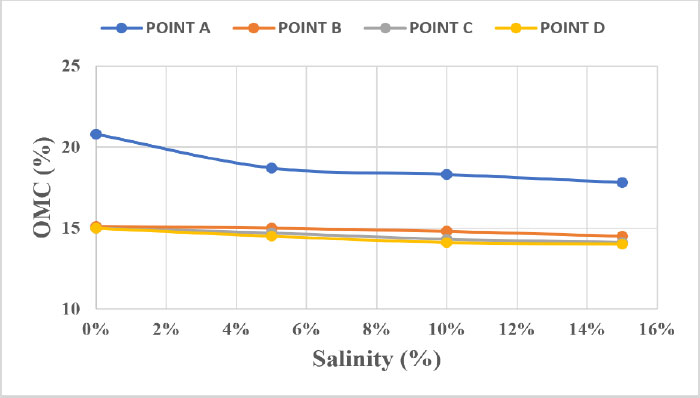
Variation of OMC with salinity.
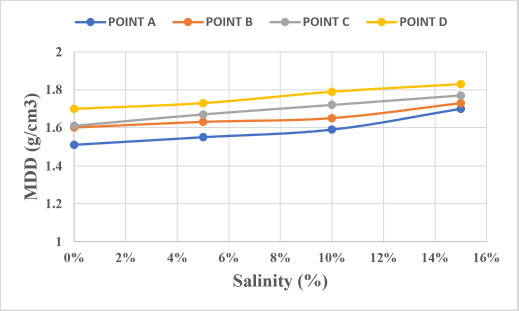
Variation of MDD with salinity.
The observed decrease in OMC and increase in MDD may be attributed to the compression of the diffuse double layer surrounding clay particles and the resulting increase in interparticle attractive forces as pore-water salinity increases.
3.5. Shear Stress Parameters
Direct shear tests were conducted on the soil from point D to evaluate the influence of salinity on the shear strength characteristics of non-cohesive soil at that location. The Normal stress values were plotted against the corresponding shear stress values obtained at different salinity levels, as shown in Fig. (7). The relationship between friction angle and salt concentration is presented in Fig. (8). It is evident that the angle of internal friction decreases as the salt content of the soil increases. This reduction may be attributed to a decrease in direct particle contact resulting from the thickening of the bound-water film. In addition, dissolved salt particles may act as lubricants within the soil pores, thereby reducing particle interlocking and altering particle surface roughness. This observation is consistent with the findings of [10], who reported that increasing salinity reduces the angle of internal friction of soils.
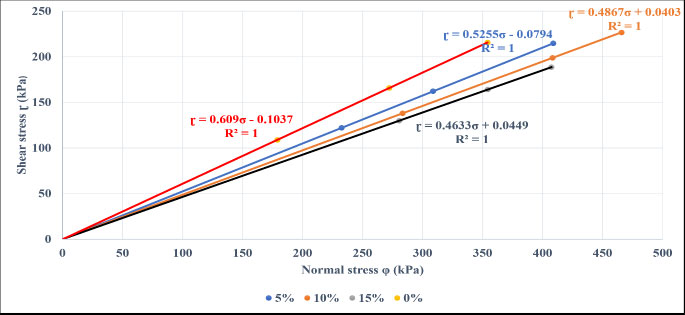
Mohr–Coulomb failure envelopes of cohesionless soil at different salinity levels.
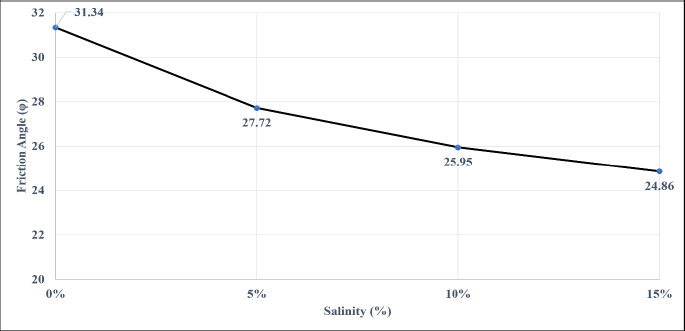
Variation of friction angle with salinity.
To evaluate the influence of salinity on the shear-strength parameters of the cohesive soils, consolidated undrained (CU) triaxial compression tests were conducted on samples obtained from Points A, B, and C. The Mohr–Coulomb failure criterion was used to determine the shear-strength parameters. The minor principal stress (σ3) and major principal stress (σ1) obtained from the tests were used to calculate the normal stress, shear stress, cohesion, and angle of internal friction using Eqs. (2-4), respectively. The calculated undrained total-stress parameters presented in Table 5 indicate that soil cohesion increased with increasing salinity, while the angle of internal friction exhibited a slight decrease. These findings suggest that saltwater intrusion promotes flocculation by reducing the thickness of the diffuse double layer surrounding clay particles, resulting in particle aggregation and stronger interparticle bonding, thereby increasing cohesion.
| Location / Shear Strength Parameters | 0% | 5% | 10% | 15% | |
|---|---|---|---|---|---|
| Point A | C (kPa) | 34 | 37 | 42.55 | 48 |
| ϕ (o) | 4.25 | 4.3 | 4.57 | 4.4 | |
| Point B | C (kPa) | 42 | 49 | 51 | 58 |
| ϕ (o) | 1 | 1.2 | 0.57 | 1.39 | |
| Point C | C (kPa) | 17.3 | 17.34 | 19.5 | 26 |
| ϕ (o) | 1.002 | 2.23 | 2.05 | 1.604 | |
| Point D | C (kPa) | 0 | 0 | 0 | 0 |
| ϕ (o) | 31.34 | 27.72 | 25.95 | 24.86 | |
These findings are consistent with those reported by [10], who observed that soil cohesion initially decreased at low salt concentrations (1–1.5%) but increased when the salt concentration reached approximately 2%. The authors attributed this behavior to the saturation of the pore solution and the cementation effect of precipitated salt crystals, which enhanced the bonding strength between clay particles. In the present study, the effect of salinity on the angle of internal friction was relatively small. The slight reduction observed may be attributed to the lubricating effect of salt particles within the soil matrix, resulting in reduced interparticle friction and bonding. Furthermore, the generally low friction angles obtained may be associated with the undrained testing conditions and the degree of specimen saturation.
Figure 9 presents a summary of the variation of cohesion with salinity level.
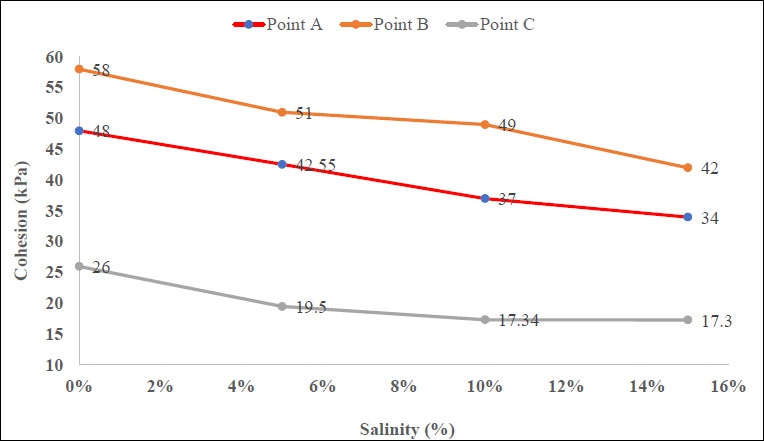
Variation of cohesion with salinity.
4. STUDY LIMITATIONS
This study was limited to soil depths shallower than 3 m due to financial constraints. Consequently, the findings may not be directly applicable to deeper soil profiles. Further research is recommended to investigate the influence of saltwater intrusion on the shear-strength properties of coastal soils at depths greater than 3 m. Future studies should also focus on evaluating the long-term effects of saltwater intrusion, conducting field-scale investigations to validate laboratory findings, and developing numerical models capable of simulating the impact of salinity on soil behavior and geotechnical performance. In addition, replicate tests were not conducted for each salinity level due to resource constraints; therefore, statistical parameters such as standard deviation, coefficient of variation, confidence intervals, and significance tests could not be determined.
CONCLUSION
This study investigated the influence of saltwater intrusion on the shear-strength properties of coastal soils in Ikot Abasi, Nigeria. Based on the laboratory test results, the following conclusions are drawn: Increasing salinity reduced the liquid limit by 23.2–32.0% and the plastic limit by 7.0–14.6%, resulting in lower plasticity indices and reduced shrink–swell potential. The Optimum Moisture Content (OMC) decreased with increasing salinity, while the maximum dry density (MDD) increased. At 15% salinity, OMC decreased by up to 14.4%, whereas MDD increased by up to 12.6%. For the non-cohesive soil (Point D), the angle of internal friction decreased by approximately 20% as salinity increased from 0% to 15%. For the cohesive soils (Points A, B, and C), salinity increased soil cohesion due to particle flocculation and enhanced interparticle bonding. However, the friction angle showed only a slight reduction and no consistent trend with increasing salinity. The results demonstrate that saltwater intrusion alters the engineering behaviour of coastal soils by modifying their consistency limits, compaction characteristics, and shear-strength parameters.
These findings highlight the need to account for salinity effects in the design and construction of geotechnical infrastructure in coastal environments.
AUTHORS’ CONTRIBUTIONS
All authors were involved in conception and design, data collection, analysis and interpretation of results, manuscript drafting, reviewed and approval of the final version of the manuscript.
LIST OF ABBREVIATIONS
| FUTIA | = Federal University of Technology, Ikot Abasi |
| AASHTO | = American Association of State Highway and Transportation Officials |
| OMC | = Optimum Moisture Content |
| MDD | = Maximum Dry Density |
| NaCl | = Sodium Chloride |
| ppm | = Parts per Million |
| ASTM | = American Society for Testing and Materials. |
| NTU | = Nephelometric Turbidity Units |
| pH | = Potential of Hydrogen |
| GC | = Clayey gravel |
| GW-GM | = Well graded gravel with silt |
| N/A | = Not applicable |
| PI | = Plasticity index |
| PL | = Plastic limit |
AVAILABILITY OF DATA AND MATERIALS
The data supporting the findings of this article are not publicly available. However, the corresponding author [E.A.J.] may make summary data available upon reasonable request.
FUNDING
This project was financially supported by the Tertiary Education Trust Fund (TETFund) Institution-Based Research (IBR) for the Federal University of Technology, Ikot Abasi, Nigeria, Award/Grant Number: TETF/DR& D/CE/UNI/IKOTABAS/IBR/2024/VOL.1.
ACKNOWLEDGEMENTS
The authors acknowledge the Tertiary Education Trust Fund (TET Fund) for providing the funding for this research and the Geotechnical Engineering Laboratory, Department of Civil Engineering, University of Uyo, for providing laboratory facilities, technical support, and assistance throughout this research.