All published articles of this journal are available on ScienceDirect.

A Performance-based Eco-efficiency Framework for Green Concrete Incorporating Silica Fume and Recycled Aggregates

Abstract
Introduction
This study evaluates the combined use of silica fume (SF) and recycled coarse aggregates (RCA) in green concrete and proposes a CO2-efficiency-based index to compare mixtures that considers both environmental impact and engineering performance.
Methods
Concrete mixtures were prepared with a constant water-to-cement ratio of 0.4. SF was used as a partial cement replacement at 5%, 10%, and 15%, while RCA replaced natural coarse aggregates at 25%, 50%, and 75%. A control mixture without replacement was used for comparison. Slump, compressive strength, splitting tensile strength, porosity, electrical resistivity, and water absorption were measured. Each result was normalized against the control mixture and combined with calculated CO2 emissions to assess eco-efficiency.
Results
SF improved strength and durability-related properties, mainly through matrix densification and pore refinement, with the best overall performance observed at 10–15% replacement. RCA reduced workability and progressively lowered strength and durability performance, especially at higher replacement levels, due to its higher porosity and weaker aggregate–paste interface. The eco-efficiency analysis showed that SF-containing mixtures achieved a better performance-to-emission balance, whereas RCA-only mixtures did not necessarily improve overall efficiency despite lower emissions.
Discussion
The findings indicate that lower CO2 emissions alone are not sufficient to define sustainable concrete. Performance loss must also be considered, particularly when high RCA contents are used.
Conclusion
The proposed index provides a practical basis for comparing green concrete mixtures. The results suggest that SF is the main contributor to improved eco-efficiency, while RCA should be used at controlled levels.
1. INTRODUCTION
The shift towards sustainable construction materials is increasingly crucial. This movement is pushed by the urgent need to reduce greenhouse gas emissions, protect our natural resources, and effectively manage the growing volumes of waste generated by construction and demolition activities [1, 2]. The concrete industry, a major consumer of raw materials, plays a pivotal role in addressing environmental challenges. Specifically, the production of Ordinary Portland Cement (OPC) significantly contributes to global CO2 emissions, while the ongoing extraction of natural aggregates results in resource reduction and environmental degradation [3-5]. There is a growing demand for concrete mixtures that prioritize environmental performance while maintaining engineering reliability.
Among the available approaches, incorporating recycled coarse aggregates (RCA) derived from construction and demolition waste, along with supplementary cementitious materials (SCMs) such as silica fume (SF), has received considerable attention [6-11]. The use of RCA supports circular economy objectives by reducing landfill disposal, limiting the demand for natural aggregates, and lowering the environmental burden associated with raw material extraction, processing, and transportation [12]. However, recycled aggregates are commonly characterized by adhered mortar, higher porosity, and increased water absorption, which can affect the mechanical and durability properties of concrete [13-17]. These limitations are primarily due to a weaker, more heterogeneous interfacial transition zone (ITZ), which governs the overall performance of recycled aggregate concrete [18-22]. The presence of adhered mortar on recycled aggregates creates multiple ITZs. It increases local porosity and microcracking, resulting in weaker bonding between the aggregate and cement matrix and consequently reducing mechanical strength and durability compared with conventional concrete [23]. The interfacial transition zone (ITZ) is widely recognized as a pivotal region that influences the mechanical properties of concrete. Its degradation in recycled aggregate concrete is widely regarded as a primary factor contributing to the observed decline in overall material performance [24, 25].
Silica fume has been widely used to address these deficiencies because of its significant pozzolanic reactivity and its ultra-fine particle size. Its incorporation promotes microstructural densification by forming additional calcium silicate hydrate (C–S–H), reduces pore connectivity, and improves the ITZ between aggregates and the cement matrix [26-28]. Previous studies have shown that combining SF and RCA can improve compressive strength, reduce permeability, and enhance durability-related properties such as water absorption and chloride resistance [27, 29-33]. When properly designed, such mixtures can reduce the performance gap between recycled aggregate and conventional concrete, supporting their potential use in structural applications.
Despite these developments, designing sustainable concrete mixtures remains complex because multiple performance requirements must be considered simultaneously. Increasing RCA content can improve resource efficiency but may reduce durability, while reducing cement content lowers CO2 emissions but may affect strength development [2, 21, 34]. Similarly, although silica fume can improve durability, it may also affect workability and require adjustments in mixture design [27].
A significant limitation remains in conventional methods for evaluating green concrete mixtures. Many studies examine mechanical and durability performance separately from environmental impact, particularly CO2 emissions. As a result, practical methods for directly comparing concrete mixtures based on eco-efficiency are still limited. Existing approaches also rarely combine several durability-related indicators, such as porosity, electrical resistivity, and water absorption, together with strength in a single framework. In addition, the assumption that increasing recycled material content automatically improves sustainability needs to be examined in light of potential performance trade-offs.
The novelty of the proposed framework lies in integrating multiple mechanical and durability indicators, along with a normalized CO2 emission index, into a single eco-efficiency metric. This allows the performance– sustainability trade-off to be evaluated directly and provides a practical basis for ranking alternative concrete mixtures using both engineering and environmental criteria.
To address these issues, this study proposes a CO2 efficiency-based evaluation framework for green concrete incorporating RCA and SF. The approach combines a CO2 emission index with normalized performance indices, including compressive strength, splitting tensile strength, porosity, electrical resistivity, and water absorption, using the control mix as a reference. This enables consistent comparison between mixtures and supports the evaluation of trade-offs between environmental impact and engineering performance.
The objective of this study is to develop a practical framework for assessing eco-efficiency by jointly evaluating CO2 emissions, mechanical performance, and durability-related properties. The study quantifies the influence of RCA content and SF dosage and identifies mixture configurations that provide a balanced compromise between performance and environmental impact.
The central hypothesis is that sustainable concrete design is governed by the balance between matrix quality and aggregate characteristics rather than by maximizing individual substitutions. Silica fume is expected to improve performance through microstructural refinement, while recycled aggregates reduce environmental impact but may introduce limitations at higher replacement levels. Therefore, an appropriate combination of these materials is expected to provide a more balanced response.
Taken together, this work contributes to the development of a practical approach for low-carbon concrete mixture design. The proposed framework serves as a decision-making tool to identify mixtures based on eco-efficiency and to balance CO2 reduction with mechanical performance and durability.
2. METHODOLOGY
2.1. Material
The study employed Ordinary Portland Cement (OPC) conforming to ASTM Type I specifications as a general-purpose cement. Potable tap water, visually inspected to ensure the absence of impurities that could affect concrete performance, was used for mixing. The fine aggregate consisted of silica sand with a particle size ranging from 0 to 4 mm, while the natural coarse aggregate ranged from 4 to 10 mm; both met the requirements of ASTM C778. The recycled coarse aggregate (RCA) was selected to match the 4 to 10 mm size range of the natural coarse aggregate. A high-range water-reducing admixture conforming to ASTM C494 was incorporated to achieve the desired workability.
The silica fume used in this study was a commercial powdered silica fume classified as Class 1 in accordance with DIN EN 13263-1. It consisted mainly of amorphous silica, with a density of approximately 2.2 g/cm3, a BET specific surface area of approximately 20 m2/g, and a bulk density of approximately 0.50 g/cm3. The chemical compositions of the cement and silica fume are presented in Table 1.
| Oxide (%) | Cement | Silica Fume |
|---|---|---|
| SiO2 | 18.47 | 93.8 |
| AL2O3 | 4.27 | 0.7 |
| CaO | 64.09 | 0.7 |
| Fe2O3 | 2.06 | 0.2 |
| MgO | 2.08 | 0.1 |
| SO3 | 4.25 | 1.1 |
| K2O | 0.28 | 0.8 |
| TiO2 | 0.11 | 1.1 |
| LOI | 4.2 | - |
The recycled coarse aggregates were obtained from demolished concrete debris (Fig. 1). The collected concrete waste was first cleaned to remove contaminants, and then crushed with a jaw crusher and subjected to secondary crushing to produce aggregates within the target size range. The crushed material was sieved; oversized particles were reprocessed; and the recycled aggregates were finally washed and conditioned to a saturated surface-dry (SSD) state to ensure accurate control of the mix's effective water content. The physical properties of the natural fine aggregate (NFA), natural coarse aggregate (NCA), and recycled coarse aggregate (RCA), including specific gravity, unitary mass, and water absorption, are summarized in Table 2.
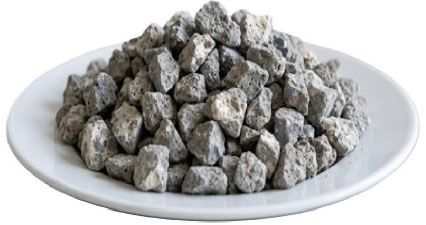
Recycled coarse aggregate.
| Properties | NFA | NCA | RCA |
|---|---|---|---|
| Specific gravity (g/cm3) | 2.61 | 2.74 | 2.4 |
| Unitary mass (g/cm3) | 1.56 | 1.62 | 1.21 |
| Water absorption (%) | 0.91 | 0.53 | 7.52 |
2.2. Mixture
The experimental matrix was designed to investigate the individual and combined effects of silica fume (SF) and recycled coarse aggregates (RCA), with baseline factors held constant across all mixtures, as summarized in Table 3. All mixtures were prepared with a constant water-to-cement ratio (w/c) of 0.4 to enable direct comparison. The superplasticizer dosage was also kept constant across all mixtures to enable direct evaluation of the effects of silica fume and recycled coarse aggregate on workability and other performance properties. The control mixture (C0.4) was produced without material substitution. Silica fume was incorporated as a partial cement replacement at 5%, 10%, and 15%, with all other parameters held constant to isolate its effect.
| Mixture | Cement (Kg) | Water (Kg) | FA (Kg) | CA (Kg) | SP (Kg) | SF (%) | SF (Kg) | RCA (%) | RCA (Kg) |
|---|---|---|---|---|---|---|---|---|---|
| C0.4 | 380 | 152 | 890 | 925.0 | 3.6 | 0 | 0 | 0 | 0 |
| W0.4SF5 | 361 | 152 | 890 | 925.0 | 3.6 | 5 | 19 | 0 | 0 |
| W0.4SF10 | 342 | 152 | 890 | 925.0 | 3.6 | 10 | 38 | 0 | 0 |
| W0.4SF15 | 323 | 152 | 890 | 925.0 | 3.6 | 15 | 57 | 0 | 0 |
| W0.4RA25 | 380 | 152 | 890 | 693.8 | 3.6 | 0 | 0 | 25 | 231.3 |
| W0.4RA50 | 380 | 152 | 890 | 462.5 | 3.6 | 0 | 0 | 50 | 462.5 |
| W0.4RA75 | 380 | 152 | 890 | 231.3 | 3.6 | 0 | 0 | 75 | 693.8 |
| W0.4SF5RA25 | 361 | 152 | 890 | 693.8 | 3.6 | 5 | 19 | 25 | 231.3 |
| W0.4SF5RA50 | 361 | 152 | 890 | 462.5 | 3.6 | 5 | 19 | 50 | 462.5 |
| W0.4SF5RA75 | 361 | 152 | 890 | 231.3 | 3.6 | 5 | 19 | 75 | 693.8 |
| W0.4SF10RA25 | 342 | 152 | 890 | 693.8 | 3.6 | 10 | 38 | 25 | 231.3 |
| W0.4SF10RA50 | 342 | 152 | 890 | 462.5 | 3.6 | 10 | 38 | 50 | 462.5 |
| W0.4SF10RA75 | 342 | 152 | 890 | 231.3 | 3.6 | 10 | 38 | 75 | 693.8 |
| W0.4SF15RA25 | 323 | 152 | 890 | 693.8 | 3.6 | 15 | 57 | 25 | 231.3 |
| W0.4SF15RA50 | 323 | 152 | 890 | 462.5 | 3.6 | 15 | 57 | 50 | 462.5 |
| W0.4SF15RA75 | 323 | 152 | 890 | 231.3 | 3.6 | 15 | 57 | 75 | 693.8 |
Recycled coarse aggregate was introduced by replacing natural coarse aggregate at 25%, 50%, and 75%, while maintaining a constant total aggregate content. This ensured that differences in performance were attributable solely to the presence of RCA. Combined mixtures containing both SF and RCA were also prepared to evaluate their interaction effects by simultaneously replacing cement and aggregate.
2.3. Preparation of Concrete Specimens
Concrete mixtures were prepared using a controlled mixing procedure to ensure uniformity and repeatability. All dry materials, including Ordinary Portland Cement (OPC), silica fume, fine aggregate, natural coarse aggregate, and recycled coarse aggregate, were first mixed for 3 minutes to ensure proper homogenization. The mixing water, combined with the superplasticizer, was then gradually added, and mixing continued for an additional 7 minutes to obtain a uniform, workable mixture. The total mixing time was kept constant across all batches to minimize variability. The fresh concrete was cast into molds and compacted to ensure proper consolidation. After 24 hours, the specimens were demolded and cured in water at 23 ± 2°C for 28 days before testing.
2.4. Testing Procedures
Workability was evaluated immediately after mixing using the slump test in accordance with ASTM C143. Mechanical properties were assessed at 28 days, including compressive and splitting tensile strengths. Compressive strength was determined in accordance with ASTM C39/C39M-21 using 100 × 100 × 100 mm cube specimens at a controlled loading rate of 0.3 MPa/s. Splitting tensile strength was measured in accordance with ASTM C496/C496M-17 on cylindrical specimens (110 mm × 220 mm) under diametrical loading at a rate of 0.02 MPa/s.
Durability-related properties were evaluated through electrical resistivity, porosity, and water absorption. Electrical resistivity was measured using a four-point Wenner probe on cylindrical specimens (100 mm × 200 mm). The Wenner four-electrode method, originally described in ASTM G57 for soil resistivity measurements, was adapted for concrete surface resistivity testing. Before testing, all specimens underwent the same conditioning procedure to ensure consistent moisture conditions across mixtures. Porosity was determined using a water saturation method based on oven drying at 105 ± 5°C, followed by 24-hour immersion. Water absorption was measured in accordance with ASTM C642. Specimens were oven-dried at 105 ± 5°C to a constant mass before immersion, and water absorption was subsequently determined in accordance with the ASTM C642 procedure. For each mixture, three specimens were tested for each hardened-property measurement. The reported values represent the mean, and the error bars in the figures correspond to 1 standard deviation.
2.5. Development of CO2 Emission Indices and Performance-based Index Calculation
The environmental and technical efficiency of each concrete mixture was assessed through a two-stage procedure involving: (i) calculation of the total CO2 emissions in absolute terms (kg CO2/m3), followed by normalization relative to the control mixture, and (ii) calculation of normalized single-property performance indices, which were then combined into a global performance index. Finally, the global performance index was related to the CO2 index to quantify the overall eco-efficiency of each mixture.
The total CO2 emissions of each concrete mixture were first calculated directly from the mix design proportions using material-specific carbon emission factors. In the present study, only two constituents varied among mixtures, namely cement, which was partially replaced by silica fume (SF), and natural coarse aggregate (NCA), which was partially replaced by recycled coarse aggregate (RCA). Therefore, the variation in total CO2 emissions between mixtures was governed by these substitutions. The total CO2 emission of each mixture was calculated from the mass of each constituent material and its corresponding emission factor, as shown in Eq. (1):
 (1)
(1)
where mc, mSF, mNCA, and mRCA are the masses of cement, silica fume, natural coarse aggregate, and recycled coarse aggregate in the mixture (kg/m3), and EFc, EFSF, EFNCA, and EFRCA are their corresponding carbon emission factors (kg CO2/kg). Based on published life-cycle assessment data reported in the literature [35]. The carbon emission factors adopted in this study are summarized in Table 4. It should be noted that the emission factor assigned to recycled coarse aggregate (RCA) reflects the inventory assumptions and system boundaries of the referenced studies and may vary with transportation distance, recycling technology, energy consumption, and allocation procedures.
Regarding the control mixture, which did not include silica fume or recycled coarse aggregate, the total CO2 emissions were determined using the same methodology and designated as the reference value. To enable a comparative analysis between different mixtures, the CO2 emissions were subsequently normalized relative to the control mixture, which was assigned a baseline value of 100%. Moreover, the CO2 emission index was computed in accordance with Eq. (2):
 (2)
(2)
According to this formulation, a value below 100% indicates that the mixture's CO2 emissions are lower than those of the control concrete, whereas a value above 100% indicates a higher carbon footprint. Alongside the environmental evaluation, the performance of each concrete mixture was assessed based on five properties: compressive strength, tensile strength, electrical resistivity, porosity, and water absorption. These properties were selected to represent both the mechanical behavior and the durability of the concrete. Each property was first examined in its measured absolute form and then transformed into a normalized index using the control mixture as the reference condition, with the control assigned a value of 100%.
For properties where a higher value indicates better performance, namely compressive strength, tensile strength, and electrical resistivity, the corresponding performance index was calculated using Eq. (3):
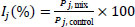 (3)
(3)
For properties where a lower value indicates better performance, namely porosity and water absorption, the inverse performance index was calculated using Eq. (4):
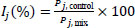 (4)
(4)
This normalization ensures that all indices share the same interpretation: a higher value always indicates better performance relative to the control mixture. Accordingly, the five individual performance indices were defined using Eqs. (5–9):
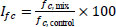 (5)
(5)
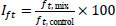 (6)
(6)
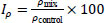 (7)
(7)
 (8)
(8)
 (9)
(9)
where fc is compressive strength, ft is tensile strength, ρ is electrical resistivity, por is porosity, and abs is water absorption. With this formulation, the control mixture has a value of 100% for all indices; values above 100% indicate improved performance, and values below 100% indicate reduced performance relative to the control.
To facilitate a comprehensive assessment of technical performance, the five normalized indices were amalgamated into a single overall performance index. Given the absence of a universally accepted weighting scheme for integrating the selected performance indicators into a single eco-efficiency metric, equal weighting was employed to mitigate subjective bias and maintain transparency in comparisons among mixtures. Consequently, the global performance index was computed using Eq. (10).
 (10)
(10)
This equal-weight method offers a balanced view of both mechanical and durability characteristics. Including tensile strength in the index is especially important, as it indicates concrete's resistance to cracking and enhances the description of mechanical performance alongside compressive strength.
Finally, the overall eco-efficiency of each mixture was assessed by comparing the global performance index to the normalized CO2 emission index. This relationship is shown in Eq. (11):
 (11)
(11)
According to this definition, a value greater than 1 indicates that the mixture demonstrates superior overall performance per unit of CO2 emissions when compared to the control mixture. A value of 1 indicates equivalent eco-efficiency, while a value less than 1 indicates inferior overall efficiency. This methodology establishes a transparent and reproducible framework for assessing green concrete mixtures, accounting for environmental impact, mechanical performance, and durability-related attributes. The two-step normalization procedure, consisting of absolute calculations followed by comparisons with the control mix, ensures both meaningful interpretation and consistency in evaluating alternative mix designs.
3. RESULTS AND DISCUSSIONS
3.1. Overview of Concrete Properties
3.1.1. Workability
The decrease in workability is influenced more by the fresh-state properties than by the hardened microstructure, as shown in Fig. (2). A gradual decline in slump was observed as RCA content increased, reaching 125 mm at 75% replacement. This trend is due to the higher surface roughness, angularity, and water absorption of recycled particles, which increase internal friction and reduce the availability of free water [37-39]. Similarly, SF led to a more obvious reduction, with the slump dropping to 145 mm at 15%. This is attributed to its ultrafine particles and high specific surface area, which markedly increase water demand and paste cohesiveness, as extensively documented in the literature [40-44]. When combined, these effects result in a minimum slump of 110 mm for the SF15RA75 mixture. This shows that the decrease in workability is due to both the reduction in free water and the rise in flow resistance.
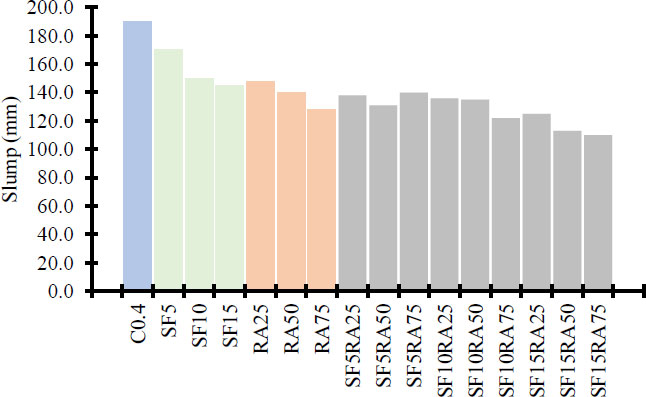
Workability for all mixtures.
3.1.2. Compressive Strength
The compressive strength results are shown in Fig. (3). The graph indicates that the control mix has the highest baseline performance, while changes in SF and RA content strongly influence strength development. The highest strength occurs at 10% SF replacement, suggesting this is the optimal level for matrix densification. Conversely, the lowest strength occurs at the highest RA replacement level (75%), highlighting the negative impact of recycled aggregates at high percentages. For mixed variants, a partial recovery in strength is observed, especially at moderate SF and RA levels (e.g., SF10RA25), where performance is close to or slightly better than the control. The mechanical behavior clearly reflects a balance between RCA-induced weakening and SF-induced strengthening, with maximum performance at moderate SF levels and some recovery in combined mixes. Adding SF alone increases compressive strength, peaking at 10% replacement, while RCA causes a steady decrease, particularly at high levels. This decline is linked to the poorer mechanical quality of recycled aggregates, which contain adhered mortar and microdefects that weaken stress transfer under load, a common issue in recycled aggregate concrete [14, 45-47].
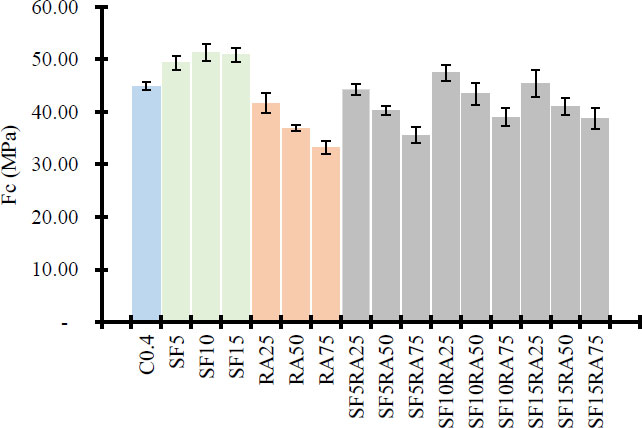
Compressive strength of various mixtures.
3.1.3. Tensile Strength
Figure 4 displays the tensile strength results. The graph shows that adding silica fume gradually increases tensile strength relative to that of the control mix, with notable gains up to a 10% replacement. Beyond this point, the values tend to plateau or slightly decrease. Mixtures with recycled aggregates show a steady decline in tensile strength relative to the control, decreasing nearly linearly as RCA content rises from 25% to 75%, highlighting a strong link between tensile performance and RCA proportion. For blends with both materials, silica fume partially counteracts the strength loss caused by RCA at low to moderate replacement levels, enabling some mixes to match or slightly outperform the control. However, higher RCA levels still lead to significant strength reductions.
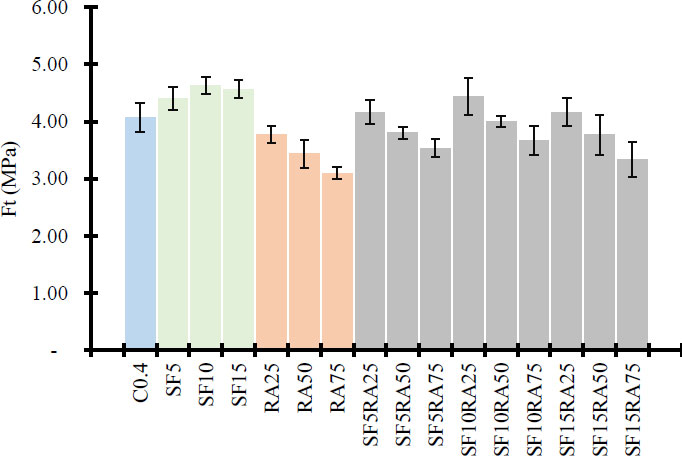
Tensile strength of various mixtures.
Tensile strength showed a similar pattern but was more affected by RCA, indicating that local defects play a key role in initiating and spreading cracks [48, 49]. SF enhanced tensile performance by increasing matrix density and strengthening interfacial bonds, which helps in reducing crack initiation [50], but its effectiveness remained limited at higher RCA contents. In mixed compositions, incorporating SF partially restored both compressive and tensile strengths. The SF10RA25 mixture outperformed the control, demonstrating that matrix densification can offset aggregate weaknesses at moderate replacement levels.
3.1.4. Porosity
Figure 5 displays the porosity results. The graph indicates that mixtures with silica fume exhibit a steady decrease in porosity relative to the control, with the lowest values at higher replacement rates, particularly at 15% SF. Conversely, adding recycled aggregates results in a consistent increase in porosity relative to the control, with values increasing from 25% to 75% RCA. In mixed formulations, silica fume helps reduce the increase in porosity at low to moderate RCA levels, allowing some mixes, like SF10RA25, to achieve values near or slightly below the control. However, higher RCA contents still lead to significantly higher porosity.
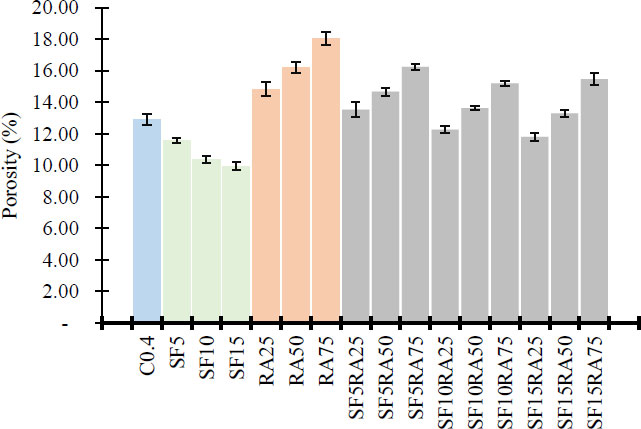
Porosity of various mixtures.
The evolution of porosity directly reflects the material's internal void structure. The use of RCA significantly increased porosity, reaching its highest value at 75% replacement, due to the porous nature of adhered mortar and the presence of internal microcracks within recycled aggregates, as commonly seen in earlier research [51]. In contrast, SF reduced porosity, with the lowest value at 15% replacement, highlighting its effectiveness as both a microfiller and a pozzolanic material that refines the pore structure and reduces connectivity [44]. In the combined mixture, SF reduced the cement matrix porosity but could not eliminate the inherent porosity of recycled aggregates. Consequently, mixtures such as SF10RA25 showed minor improvements over the control, while higher RCA levels remained primarily influenced by aggregate porosity.
3.1.5. Water Absorption
The water absorption results are shown in Fig. (6). The graph shows a trend closely correlated with porosity; silica fume reduces water absorption relative to the control mixture, with this reduction becoming increasingly significant as the SF content increases, reaching the lowest values at a 15% replacement. Conversely, recycled aggregates exhibit a notable increase in water absorption compared to the control, with a clear upward trend as the RCA content increases from 25% to 75%. For combined mixtures, silica fume partially mitigates the RCA-induced rise at low to moderate replacement levels, resulting in absorption values that approximate those of the control. Meanwhile, mixtures with higher RCA content persistently demonstrate elevated absorption.
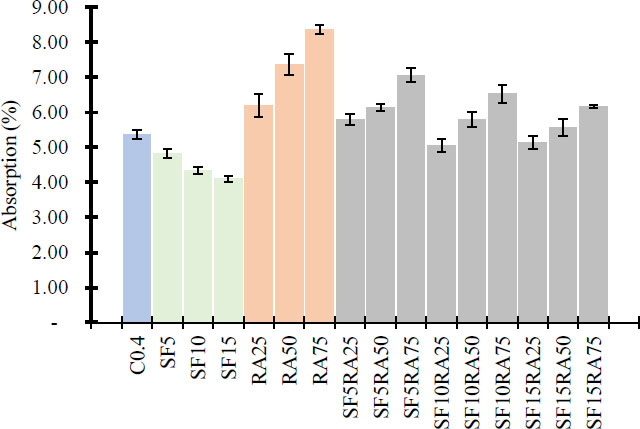
Water absorption of various mixtures.
Transport-related properties further emphasize the distinction between aggregate-controlled and matrix-controlled mechanisms. Water absorption increased significantly with RCA, reaching its maximum at 75% replacement, which is mainly attributed to the high absorption capacity of recycled aggregates acting as water reservoirs due to their porous residual mortar [2, 41]. In contrast, SF minimized water absorption, achieving the lowest level at 15% replacement, owing to pore refinement and reduced permeability.
3.1.6. Electrical Resistivity
The electrical resistivity results are illustrated in Fig. (7). The graph indicates that the inclusion of silica fume consistently increases resistivity compared to the control mix, with the highest values recorded at a 15% replacement level. Conversely, mixtures containing recycled aggregate exhibit lower resistivity than the control, with values decreasing progressively as the recycled concrete aggregate (RCA) content increases. In combined mixtures, the addition of silica fume improves resistivity at low to moderate RCA levels, enabling some mixtures to approach or even surpass the control values. However, at higher RCA contents, resistivity declines noticeably, highlighting the main impact of RCA at elevated replacement levels.
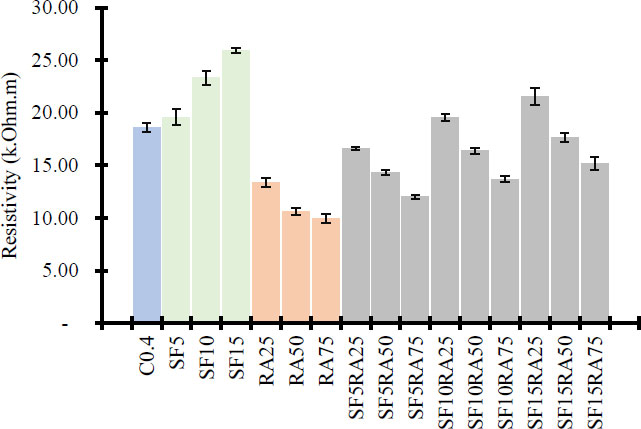
Electrical resistivity of various mixtures.
Electrical resistivity exhibited a complementary trend, with RCA reducing resistivity due to increased pore connectivity and enhanced ionic transport [52-54], while SF significantly increased resistivity, with the highest value obtained at 15% replacement, reflecting the disruption of conductive pathways within the pore network [55-57]. In combined mixtures, SF improved both absorption and resistivity compared to RCA-only concrete, particularly at low RCA levels. However, its effectiveness decreased as the influence of aggregate porosity and connectivity became dominant.
3.2. CO2 Emissions and Eco-efficiency Analysis
To complement the performance-based evaluation, the environmental impact of each mixture was assessed using a CO2 index and an eco-efficiency framework, shown in Table 5. First, the total CO2 emissions for each mixture were calculated using Eq. (1), then normalized using Eq. (2) to derive the CO2 index. The individual performance indices listed in Table 5 were obtained via normalization procedures outlined in Eqs. (3 and 4) and expressed in Eqs. (5–9). The combined performance and eco-efficiency indices were subsequently calculated using Eqs. (10 and 11). This methodology enables an integrated analysis of mechanical and durability performance alongside embodied CO2 emissions, facilitating the identification of mixtures that balance engineering performance and environmental sustainability.
| Mixture | CO2 Index (%) | Performances Index | Combined Index (%) | Eco Efficiency | ||||
|---|---|---|---|---|---|---|---|---|
| Fc Index (%) | FT Index (%) | Porosity Index (%) | Resistivity Index (%) | Absorption Index (%) | ||||
| C0.4 | 100.00 | 100.00 | 100.00 | 100.00 | 100.00 | 100.00 | 100.00 | 1.00 |
| SF5 | 96.22 | 109.87 | 108.20 | 111.82 | 105.38 | 111.03 | 109.26 | 1.14 |
| SF10 | 92.44 | 114.25 | 113.93 | 124.76 | 125.45 | 123.85 | 120.45 | 1.30 |
| SF15 | 88.66 | 113.29 | 112.30 | 130.20 | 139.43 | 130.89 | 125.22 | 1.41 |
| RA25 | 94.41 | 92.72 | 92.62 | 87.19 | 72.04 | 86.56 | 86.23 | 0.91 |
| RA50 | 88.81 | 82.26 | 84.43 | 79.84 | 56.99 | 72.85 | 75.27 | 0.85 |
| RA75 | 83.22 | 74.02 | 76.23 | 71.59 | 53.41 | 64.14 | 67.88 | 0.82 |
| SF5RA25 | 90.62 | 98.74 | 102.46 | 95.57 | 89.25 | 92.53 | 95.71 | 1.06 |
| SF5RA50 | 85.03 | 89.68 | 93.44 | 88.18 | 77.06 | 87.50 | 87.17 | 1.03 |
| SF5RA75 | 79.44 | 79.29 | 86.89 | 79.67 | 64.52 | 75.94 | 77.26 | 0.97 |
| SF10RA25 | 86.84 | 105.79 | 109.02 | 105.43 | 105.38 | 105.92 | 106.31 | 1.22 |
| SF10RA50 | 81.25 | 96.81 | 98.36 | 94.87 | 88.17 | 92.53 | 94.15 | 1.16 |
| SF10RA75 | 75.65 | 86.93 | 90.16 | 85.09 | 73.66 | 82.14 | 83.60 | 1.10 |
| SF15RA25 | 83.06 | 101.26 | 102.46 | 109.60 | 115.77 | 104.55 | 106.73 | 1.28 |
| SF15RA50 | 77.47 | 91.17 | 92.62 | 97.24 | 94.80 | 96.41 | 94.45 | 1.22 |
| SF15RA75 | 71.87 | 86.27 | 81.97 | 83.62 | 81.54 | 87.03 | 84.08 | 1.17 |
3.2.1. CO2 Emission Index Analysis
The CO2 index spans from 71.87% to 100%, with the control mixture (C0.4) serving as the reference. The lowest value, 71.87%, occurs with SF15RA75, while intermediate values are associated with partial substitutions. Overall, the trend shows a decrease as material replacement increases, but the reduction isn't strictly linear due to the combined effects of binder and aggregate substitutions.
A clear sensitivity to binder composition is evident. Increasing silica fume content consistently lowers CO2 emissions, with the index dropping from 96.22% (SF5) to 88.66% (SF15). This indicates that modifying the binder significantly reduces emissions, aligning with the well-known impact of cement production on total embodied CO2 [58, 59]. Recycled aggregates show a different trend, with the CO2 index dropping from 94.41% (RA25) to 83.22% (RA75). This represents a moderate decrease in emissions compared to silica fume, highlighting the lesser impact of aggregates on overall emissions [60].
In combined mixtures, the reduction is more significant, dropping below 80% at higher substitution levels. Nonetheless, silica fume continues to play a key role, indicating that CO2 reduction is mainly driven by cement replacement, with recycled aggregates making a secondary, though less important, contribution.
3.2.2. Individual Property-based Performance Indices
The individual performance indices vary widely, showing both improvements and declines depending on the material combination. The highest performance is seen in SF-only mixes, especially SF10 and SF15. SF10 demonstrates the highest compressive (114.25%) and tensile strengths (113.93%), while SF15 leads in durability measures such as porosity (130.20%), resistivity (139.43%), and absorption (130.89%). This suggests that increasing SF content shifts focus from mechanical improvements to durability enhancements. In contrast, RCA-only mixes consistently show declines across all indices. RA75 has the lowest values, with compressive strength at 74.02%, tensile strength at 76.23%, porosity at 71.59%, resistivity at 53.41%, and absorption at 64.14%. The reductions are particularly notable in durability-related properties, especially resistivity, indicating greater sensitivity to RCA content.
In combined mixtures, the response reflects a balance between improvement and degradation. At low RCA levels, SF maintains performance above or near the control, as observed in SF10RA25 and SF15RA25, with most indices exceeding 100%. As RCA content increases, the magnitude of improvement decreases, and the indices progressively fall below the control, as seen in SF5RA75 and SF10RA75. This behavior indicates that the interaction between SF and RCA is not linear. While SF enhances performance, its effectiveness decreases as RCA content increases, leading to a transition from matrix-controlled to aggregate-controlled behavior [61, 62].
3.2.3. Combined Performance Index Evaluation
The combined performance index ranges from 67.88% to 125.22%, with SF15 at the highest (125.22%), followed by SF10 (120.45%), and RA75 at the lowest (67.88%). In SF mixtures, the increase in the combined index is primarily driven by durability-related properties. Although mechanical properties show a moderate improvement, the significant increases in resistivity and pore-related indices contribute more strongly to the overall performance. In RCA-only mixtures, the reduction in the combined index is consistent and progressive, with values decreasing from 86.23% (RA25) to 67.88% (RA75). The decline is mainly governed by durability-related properties, particularly resistivity and absorption, which show the largest reductions.
The behavior of combined mixtures varies with RCA content. At lower RCA levels, such as SF10RA25 and SF15RA25, the combined index remains above the control values (106.31% and 106.73%), indicating that SF effectively offsets the recycled aggregates. As RCA levels rise, the combined index gradually drops, falling below 100% in mixtures such as SF5RA75 and SF10RA75. These findings suggest that durability-related properties play a significant role in the combined index, and to keep performance above the control, RCA content must be kept at moderate levels.
3.2.4. Eco-efficiency Assessment
The eco-efficiency index ranges from 0.82 to 1.41, with the control mixture set at 1.00. SF15 has the highest index, 1.41, followed by SF10 at 1.30. In contrast, RCA-only mixtures, especially RA75 (0.82) and RA50 (0.85), display the lowest values. This variation indicates that eco-efficiency is highly sensitive to the balance between performance and CO2 reduction. A clear trend emerges in SF-only mixtures, where eco-efficiency improves as replacement levels increase, driven by improved durability and lower CO2 emissions from cement substitution. Although strength increases moderately, notable improvements in resistivity, porosity, and absorption significantly boost the performance index, leading to overall better eco-efficiency. This suggests durability enhancement is crucial for maximizing eco-efficiency. Conversely, mixtures containing only RCA consistently demonstrate eco-efficiency values below 1.00. Specifically, RA75's CO2 index decreases to 83.22%, yet its eco-efficiency declines to 0.82. This indicates that performance losses, especially in durability-related properties, outweigh environmental benefits. The findings emphasize that reducing CO2 alone isn't enough for sustainability if it causes a substantial decline in performance. Similar trade-offs between recycled aggregate use and mechanical performance have been documented in other studies [63].
The behavior of combined SF–RCA mixtures offers a deeper understanding of the trade-offs between these effects. At low to moderate RCA levels, eco-efficiency remains above one, as seen in SF10RA25 (1.22), SF15RA25 (1.28), and SF10RA50 (1.16). In these cases, silica fume effectively mitigates the negative effects of recycled aggregates, ensuring good performance while reducing CO2 emissions. This shows that matrix refinement can compensate for aggregate deficiencies when substitution levels are kept in check. As RCA content increases, eco-efficiency gradually drops, indicating performance losses grow more significant. Yet, some mixes like SF15RA75 (1.17) still stay above one, showing that CO2 reduction advantages become more prominent at higher substitution levels. This points to a shift where environmental benefits partially offset performance declines. However, mixes such as SF5RA75 (0.97) fall below one, demonstrating that without sufficient matrix enhancement, negative effects of high RCA content cannot be countered [64].
The interaction between SF and RCA can be observed by comparing the combined mixtures with the corresponding SF-only and RCA-only mixtures. While RCA alone reduced both performance and eco-efficiency, incorporating SF partially offset these losses by improving matrix quality and durability-related properties. For example, the eco-efficiency increased from 0.91 in RA25 to 1.22 in SF10RA25 and to 1.28 in SF15RA25. This demonstrates a synergistic interaction at moderate RCA contents, where matrix refinement offsets aggregate-related deficiencies and enables simultaneous performance enhancement and CO2 reduction.
From a design perspective, these results clearly demonstrate that eco-efficiency is achieved not by maximizing a single parameter but by balancing performance and emissions. Silica fume emerges as the primary driver of eco-efficiency, due to its dual role in enhancing durability and reducing CO2 emissions. In contrast, recycled aggregates must be incorporated within controlled limits to avoid excessive performance degradation. This shows that the most favorable balance is achieved in mixtures that combine moderate levels of SF with limited RCA content, particularly SF10RA25 and SF15RA25, which maintain performance above the control while achieving meaningful CO2 reduction. These findings confirm the effectiveness of the proposed index-based framework in identifying optimal mixtures and provide a practical basis for the design of sustainable concrete.
CONCLUSION
This study examined the interactions between silica fume and recycled coarse aggregates and their impact on the mechanical, durability, and environmental properties of concrete. A framework was developed to evaluate performance and eco-efficiency utilizing CO2 emissions as a metric, aiming to balance structural strength with sustainability.
The findings show that recycled aggregates influence concrete mainly through their aggregate characteristics, such as higher porosity, increased water absorption, and lower mechanical strength. As the proportion of recycled aggregates increases, there’s a noticeable decline in strength and durability. By contrast, silica fume enhances performance by densifying the matrix, refining pores, and improving interfacial bonding, resulting in significantly improved durability and a slight increase in mechanical strength. When the two materials are combined, their interaction is competitive. With low to moderate amounts of recycled aggregates, silica fume can offset some of the negative effects, allowing mixtures such as SF10RA25 and SF15RA25 to perform as well as, or even better than, standard concrete. However, at higher replacement levels, the shortcomings of recycled aggregates take precedence, and silica fume’s ability to restore performance diminishes.
From an environmental standpoint, the CO2 analysis shows that modifying the binder has a greater impact on reducing emissions, whereas changing the aggregates has a smaller impact. The eco-efficiency results highlight that silica fume is the best option for promoting sustainability, with SF15 showing the highest eco-efficiency, followed by SF10. This improvement stems from better durability coupled with lower CO2 emissions. Conversely, recycled aggregates, while helping cut emissions, result in eco-efficiency values below one due to noticeable performance drops.
In mixed combinations, eco-efficiency hinges on balancing maintained performance with reduced emissions. For moderate recycled aggregate levels, mixtures such as SF10RA25 (1.22) and SF15RA25 (1.28) strike a good balance, maintaining performance above the standard while achieving significant CO2 reductions. However, at higher recycled aggregate contents, although CO2 reductions increase, the performance loss limits overall eco-efficiency.
The integration of performance and environmental indicators shows that the most sustainable mixtures are not defined solely by the lowest emissions or the highest performance levels when considered in isolation. Instead, mixtures that strike an optimal balance between these two factors stand out. In this analysis, SF15 is the top eco-efficient mixture. At the same time, combinations of silica fume with a moderate amount of recycled aggregate offer practical solutions that effectively balance sustainability and material reuse.
LIMITATIONS AND FUTURE RESEARCH
This study has several limitations. First, the experimental program was conducted at a fixed water-to-cement ratio (w/c = 0.4), which may limit the generalizability of the results to other mix designs. Second, the evaluation focused only on short-term properties (28 days) and did not account for long-term durability factors, such as chloride penetration, carbonation resistance, and other service-life performance indicators. Third, differences among recycled coarse aggregates (RCA) were not fully examined, even though their properties can vary widely depending on their source. Fourth, there was no microstructural analysis (such as SEM, EDS, XRD, or MIP) to directly examine how silica fume improves the performance of concrete made with recycled aggregate. Thus, the explanations for pore refinement and the improvement of the interfacial transition zone are based solely on observations and are supported by previous research. Finally, the eco-efficiency assessment focused solely on carbon emissions and did not account for other environmental impacts, such as water use, energy demand, or resource depletion.
Future research should focus on validating the proposed framework under long-term durability conditions, particularly for chloride penetration and carbonation. Additionally, efforts should extend this approach to various types of recycled materials and binder systems. Moreover, incorporating predictive models, including machine learning techniques, could improve the identification of optimal low-carbon concrete mixtures and enhance the robustness of performance-environmental trade-off analyses.
AUTHORS’ CONTRIBUTIONS
The authors confirm their contribution to the paper as follows: T.F., T.D.D.: Study conception and design; T.F.: Data collection; T.F., T.D.D.: Analysis and interpretation of results; T.F., T.D.D.: Draft manuscript. All authors reviewed the results and approved the final version of the manuscript.
LIST OF ABBREVIATIONS
| CO2 | = Carbon dioxide |
| SF | = Silica Fume |
| RA | = Recycled Aggregate |
AVAILABILITY OF DATA AND MATERIALS
The data supporting the findings of this study are summarized within the manuscript. Additional experimental data are available from the corresponding author [T.F] upon reasonable request.
ACKNOWLEDGEMENTS
Declared none.